精读笔记
Problem Setting
论文标题:An Adjoint-Sensitivity Framework for Lost-in-the-Middle Phenomena in Causal Residual Transformers(arXiv preprint / 2026)。
这篇论文解决的不是通常意义上的 long-context QA/retrieval benchmark 问题,而是一个理论建模问题:给定 causal residual Transformer,如何在训练动力学中定义位置影响力,并判断边界位置优势是否能从结构机制中推出。真正困难点在于 Lost-in-the-Middle 是一个归一化相对敏感性现象,不是某个 attention head、某个 token score 或某个 terminal loss 项单独决定的。
以前路线的瓶颈在于对象不对齐:attention weight 不是 sensitivity,retrieval accuracy 又混入数据、任务、解码和 benchmark protocol;已有 closed-form birth-time theory 更接近初始化抽象,而不是训练中的 influence redistribution。本文的关键矛盾是:causal mask 和 residual path 的确提供边界偏置通道,但这些通道不一定同向,也不一定压过 middle/local/cross terms。
Motivation
作者的核心观察是:如果要严肃讨论 Lost-in-the-Middle,必须区分“结构上存在可放大边界的通道”和“最终 influence profile 真的呈 U-shape”。许多经验解释把这两者混在一起,例如认为 causal masking 自然导致 primacy、residual connection 自然导致 recency,但这在数学上不成立。
因此论文缺的不是又一个 calibration trick,而是一个能让这些说法变成可检验条件的语言。adjoint sensitivity 是合理入口,因为它直接测量 loss 对输入位置扰动的一阶敏感性;连续深度/Volterra 化则让因果结构和残差结构可以被干净地拆开。动机本质上是把 position bias 从现象归因问题转成 deterministic control / sensitivity analysis 问题。
Core Idea
核心思想是:把 Transformer 层视为 residual Euler step,把深度极限写成 controlled ODE,把 causal attention 的位置极限写成 Volterra operator,再用 backward adjoint 在输入端的平方能量定义 positional influence density。这样,Lost-in-the-Middle 被定义为 normalized adjoint-energy density 在中部低于两端,而不是某个 retrieval score 的经验曲线。
这个建模改变了信息流的组织方式。forward 中,位置 p 只看 prefix [0,p];backward adjoint 中,位置 q 接收所有 future positions p>=q 的 covector 贡献。因此 early token 的敏感性可以被 causal cone 放大。另一方面,residual identity 在 Duhamel 公式中保留 terminal adjoint 的直接项,所以如果 readout/query/loss 把 terminal sensitivity 放在右侧,右侧偏置可以传回 depth zero。与 prior 的本质区别是,本文不把 U-shape 当作 universal law,而是把它拆成 cone primacy、terminal recency、local terms 和 cross-covariance 的能量比较。
Method
方法的第一块是连续深度一致性。它解决的是:有限层 causal Transformer 是否能被连续控制系统近似。Theorem 2.8 给出 residual-to-ODE shadowing,但条件是 layer controls 的插值在 L1 中收敛;这排除了“任意深层网络自动有连续极限”的过度解读。Theorem 2.7 处理 finite-token attention 到 Volterra operator 的近似,重点在左端点奇异性,因为 causal prefix normalization 在 p->0 时 kernel 本身不良,但 averaged operator 有 trace。
第二块是 adjoint influence density。定义 I(p)=E||P0(p)||^2,再归一化成 m(p)。这解决了 position influence 的尺度问题:总梯度能量变化不等于位置偏置变化。沿 gradient flow 的精确演化式本质上是 replicator dynamics:某位置的归一化质量上升,当且仅当它的相对衰减率低于平均。
第三块是机制分解。Volterra adjoint term 对应 nonlocal causal cone,residual term 对应 terminal adjoint 的直接传输,local term 收集 tokenwise FNN/query/local derivative。必要性在于:不拆分就无法判断 primacy/recency 来自哪里;只拆分但丢 cross terms 又会错误推出边界优势。论文保留 covariance cross terms,是为了避免“两个通道各自有边界能量,所以总和也有边界能量”的错误。
第四块是 remedies:influence balancing、positional reweighting、observability balancing。它们更像 diagnostics/regularizers,而不是已证明有效的训练算法。影响力平衡直接惩罚 m 与目标密度的偏差,但需要二阶微分;reweighting 是 outer-loop response rule,不保证 LIM 单调下降;observability 只控制 selected observation 下的 perturbation visibility,不等价于 influence balance。
Key Insight / Why It Works
最核心的 insight 是反向因果几何:causal mask 在 forward 中限制信息只能从左到右聚合,但在 adjoint 中把 later loss covectors 传播回所有可能影响它们的 earlier positions。early positions 的 future cone 更大,所以 Volterra adjoint 提供 primacy 的自然通道。这不是 attention weight explanation,而是 Jacobian-adjoint geometry。
第二个关键 insight 是 recency 不是 residual connection 自己生成的。residual identity 只负责 preservation,不负责 localization。右侧优势必须来自 terminal adjoint:例如 last-token query、右偏 evaluation protocol、局部 readout 支持,或 loss 权重集中在右侧。这个判断很重要,因为它把很多“模型有 recency bias”的说法还原成 task/readout geometry 的问题。
第三个关键 insight 是 U-shape 不是两个边界通道的线性叠加那么简单。local channel 可以抬高中部,residual/cone 可以负相关,cross terms 可以反转结论。论文中显式给出反例,说明丢掉 covariance 后的解释会过强。真正成立的是 sufficient energy/correlation condition,而不是 architecture-implies-shape theorem。
我认为最实质的贡献是 normalized adjoint-energy density 及其 exact channel-energy decomposition;有限 token 到 Volterra、residual-to-ODE 这些结果是必要的数学地基,但更像保证框架合法。regularizers 目前主要是工程提案,增益来源不清。若未来实验有效,可能部分来自更好的 objective alignment / positional reweighting,而不一定来自深层的 adjoint-control 优势。这里不是 scaling story,也不是 retrieval mechanism 本身;更准确地说,它是 representation sensitivity alignment 的理论框架。
Relation To Prior Work
最接近的技术谱系有四条:input-gradient / integrated gradients,attention rollout/flow,Neural ODE adjoint sensitivity,long-context position bias / attention sink / birth-time U-shape theory。
和 attribution 工作的区别是对象不同。本文的 influence density 是 data-averaged squared input adjoint,服务于 forward-backward depth system 的能量分析;它不满足 integrated gradients 的路径公理,也不试图解释单个样本的 token attribution。和 attention rollout 的区别更直接:attention flow 传播的是 attention relevance,本文传播的是 loss covector through Jacobian adjoint。
和 Neural ODE/control literature 的关系是工具继承而非概念原创。adjoint 本身不是新东西,连续深度残差也不是新东西;新增信息在于把 causal Volterra derivative、normalized positional measure 和 residual/cone/local channel decomposition 放在同一个框架里。
和 Chowdhury 的 birth-time theory 相比,本文更条件化、更动力学化。前者给特定 causal-decoder 抽象下的 initialized U-shape;本文追踪训练轨迹中的 adjoint density,并反复强调不推出 universal U-shape。实质创新在这个“条件化拆解”上,而不是在声称发现了 Lost-in-the-Middle 的唯一原因。
Dataset / Evaluation
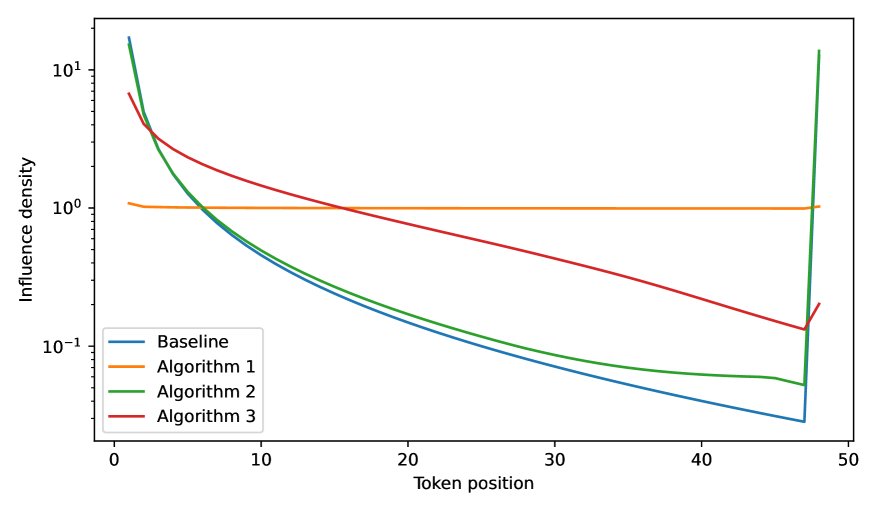
Evaluation 很弱,且作者基本承认这一点。实验是 L=48、低维、线性 Cesaro causal averaging、positionwise gates 的代数模拟,不是实际 Transformer,不是语言模型,也不是真实 long-context retrieval benchmark。它验证的是:Algorithm 1 能控制被直接参数化的 influence surrogate;Algorithm 2 在 response 不对齐时可能几乎不改善 LIM;Algorithm 3 能平衡 scalar trace observability 但不保证 influence 或 full Gramian spectrum 改善。
这些实验支持的是 implementation sanity check,不支持核心应用 claim。它们没有验证:adjoint influence 是否预测 retrieval accuracy;regularizer 是否在 shared-parameter Transformer 上有效;跨长度是否泛化;是否保持 task performance;是否存在 benchmark overlap 或 evaluation protocol bias。严格说,本文的 empirical section 只能说明 proposed diagnostics 没有在 toy algebra 中自相矛盾,不能说明它们是实用 cure。
Limitation
主要限制不是“实验少”这么简单,而是理论结论离真实模型有多层条件。连续深度需要 layer controls 有 L1 收敛;Volterra 极限需要空间正则;influence density 的可微需要二阶 Fréchet differentiability 和 moment bounds;L2 squared penalty 还需要 L4 sensitivity。真实 Transformer 的 finite depth、LayerNorm、非平滑激活、优化噪声、数据重尾、RoPE/ALiBi/attention sink、KV cache、multi-query evaluation 都可能破坏这些理想条件。
primacy/recency 的结论是 sufficient,不是 necessary,更不是 universal。文中未充分说明这些 energy/correlation bounds 在真实训练中如何稳定估计,也未说明它们是否经常成立。Theorem 3.7 可能非常保守;如果只能用 rho=1 的 Cauchy-Schwarz bound,判别力可能很差。
regularization 的上限也明显。Influence balancing 需要二阶自动微分,长上下文下成本很高;positional reweighting 改变训练风险,可能只是把模型调到某个位置分布上;observability balance 依赖 observation map,选错 C_k 就是在优化无关 surrogate。所谓“remove Lost-in-the-Middle”的增益来源不清,可能主要来自 loss weighting / task distribution matching,而不是框架本身带来的泛化。
另外,adjoint sensitivity 高不等于模型真的利用该位置完成 retrieval。它测的是 local first-order loss sensitivity,不等价于 causal factual use、multi-hop reasoning、planning 或 memory access。若未来 benchmark 改善,也需要排除 data coverage、implicit memorization、query protocol alignment 和 evaluation leakage。
Takeaway
- 第一,Lost-in-the-Middle 更应该被看作 normalized sensitivity imbalance,而不只是 attention pattern 或 retrieval score 曲线。
- 这个视角可以迁移到其他 positional robustness / modality alignment 问题。
- 第二,causal mask 和 residual path 的机制角色不同:mask 通过 adjoint cone 给 primacy 提供几何通道,residual 只保留 terminal bias,不创造 recency。
- 以后分析长上下文偏置时应显式区分 architecture channel 与 task/readout geometry。
一句话总结
这篇论文把 Lost-in-the-Middle 从经验位置偏置问题重写为 causal residual Transformer 中 normalized adjoint-energy 的条件性通道分解,是一篇偏优化控制/敏感性分析的理论框架论文,而不是证明或解决真实长上下文失败的工程方法。