精读笔记
Problem Setting
论文标题:Uniform Exponential Stability Analysis of Impulsive Linear Time-Invariant Systems on Banach and Hilbert Spaces: Non-Coercive and Coercive Stability Conditions(arXiv preprint / 2026-07-21)。
这篇论文实际解决的是无限维线性脉冲系统的 uniform exponential stability characterization:状态空间是 Banach 或 Hilbert,flow 由固定 C0-semigroup generator A 产生,jump 由有界算子 J 给出,jump time sequence 可以是固定、任意、constant dwell-time、minimum dwell-time 或 range dwell-time。
关键困难不是“有 jump”本身,而是 jump time 被钉在绝对时间上以后,传播子 U_sigma(t,s) 不再是半群,也不具有 time-translation invariance。经典 Datko 定理和半群 Lyapunov equation 依赖的结构都消失了;同时 J 可以不可逆,传播子不能回推;再叠加无限维里 exponentially stable semigroup 未必存在 coercive quadratic Lyapunov functional,这使有限维 impulsive LMI 直觉不能直接推广。
关键矛盾是:为了必要充分性,不能假设 coercive/quadratic;为了可计算性,又希望最终能落到 operator inequalities / LPIs / SOS。论文的结构基本是在这两个目标之间做分层:Banach 上给 sharp 的 non-coercive 和 Lipschitz-coercive 抽象刻画,Hilbert 上给 quadratic/operator 版本,其中一部分只能是 sufficient。
Motivation
已有路线各自缺一块。无限维线性半群稳定性理论处理的是 time-invariant semigroup;有限维 impulsive/switched 理论处理 dwell-time、timer-dependent Lyapunov 和 LMI,但默认有限维里 coercive quadratic certificate 足够自然。无限维 impulsive 系统正好破坏这两个假设:不是半群,又不能指望 coercive quadratic converse。
作者的核心观察是,脉冲系统的稳定性不能只按连续时间衰减理解,也不能只看离散 monodromy;它有两个耗散维度:flow duration 和 jump count。只要能同时控制 trajectory 的 Lp time-energy 和 pre-jump state sequence 的 l_p energy,就可以恢复一种混合指数界。
真正缺口是一个 impulsive Datko 型工具:它要在没有平移不变性、没有逆传播子、只有 evolution family 的条件下,把“从任意初始时刻 s 开始的能量有界性”转成 uniform exponential bound。后续所有 Lyapunov converse、dwell-time functional、switched-system reduction 都是在这个工具上堆出来的。
Core Idea
论文最核心的思想是把 infinite-dimensional impulsive stability 从“找一个 coercive Lyapunov operator”改写成“找一个未来尾部能量 functional”。固定序列下,functional 直接定义为从当前时间 t 往未来的积分能量加所有未来 pre-jump 状态能量;任意序列或 dwell-time family 下,则对 admissible future signals 取 supremum。这个建模方式把时间非平移不变性显式吸收到 Lyapunov functional 里,而不是试图恢复不存在的半群结构。
本质区别在于 inductive bias:传统 quadratic/operator Lyapunov 把稳定性压缩进一个当前状态二次型;本文的 non-coercive functional 记录的是“当前状态在所有 admissible future 下还能产生多少 flow energy / jump energy”。这更像可达未来尾能量,而不是等价范数。它牺牲 coercivity,换取必要充分性;再在 Hilbert/coercive 场景中把它投影回可计算 operator inequalities。这也是为什么它能覆盖 Banach 空间和 dwell-time families,但 quadratic 部分会丢必要性。
Method
1. Impulsive Datko Lemma:解决从能量有界到指数稳定的核心缺口。积分项给出按连续时间的 polynomial decay,再迭代成 exp(-alpha(t-s));pre-jump 求和项给出按 jump count 的 polynomial decay,再迭代成 rho^{kappa};插值后得到 hybrid exponential estimate。这一步是全局理论成立的原因。
2. Non-coercive Lyapunov functional:解决无限维中 coercive quadratic 不存在的问题。固定序列用未来积分+未来跳前求和;任意序列用 supremum over all admissible sequences;dwell-time 用 timer-dependent admissible future family。核心变化是 Lyapunov 不再下界控制 norm,而是通过严格下降条件推出 Datko bound,再由 Datko lemma 得稳定性。
3. Dwell-time 编码:constant dwell-time 退化成周期 monodromy;minimum dwell-time 需要 mandatory phase + free phase,因为超过 T_min 后下一跳可随时发生且存在 arbitrarily long flow interval;range dwell-time 在 [T_min,T_max] 上施加 jump condition。它解决的是时间约束如何进入证书,而不是引入新的动力学。
4. Coercive theory:不是为了 sharp converse 的数学必要性,而是为了等价范数、bounded invertibility 和 synthesis。sup-type construction 给 Lipschitz coercive functional;在 Hilbert 中 coercivity 允许 P^{-1} 变换和控制增益线性化。
5. Hilbert quadratic/operator specialization:把抽象 functional 写成 <x,P(t)x>。固定序列和 constant dwell-time 下可做 N&S,因为未来演化或 monodromy 是单例;任意/minimum/range family 下 quadratic class 不够大,所以只能给 sufficient 条件。
6. Switched systems reduction:把 switched system lift 到 product space,mode switch 变成 unit-norm selector jump。这个 reformulation 说明 switched systems 是 impulsive framework 的特例;由于 selector 不扩张,稳定性主要来自 flow,得到 persistent-flowing 类型条件。
Key Insight / Why It Works
最关键的 insight 是:对于 impulsive evolution family,稳定性必须同时在两个尺度上 uniform,时间尺度和 jump-count 尺度。只控制积分轨迹能量不够,因为瞬时 pre-jump 值可能逃逸;只控制 jump 序列不够,因为长时间无跳 interval 会暴露 flow 的不稳定。论文的 integral-plus-sum Datko 条件正好堵住这两个漏洞。
方法有效的核心贡献是 Lemma 3.4。它不是普通 Datko 的机械推广,因为经典证明依赖半群平移结构;这里必须显式处理任意 starting time s、最后一次 jump、pre-jump propagator、多段迭代和 jump-count 插值。这个 lemma 一旦成立,后面大量定理其实是把不同 timing family 的 admissible future set 写进 Lyapunov functional。
最可能只是辅助的是 coercive/quadratic 部分。它对数值和合成很重要,但理论上不是最 sharp 的稳定性刻画。尤其在 Hilbert infinite-dimensional setting,coercive quadratic certificate 的缺失是结构性问题,不是 proof 技巧问题。因此 quadratic sufficient 条件的 conservatism 是预期内的。
这篇不是 scaling/data/retrieval 类工作;它的“泛化”来自更正确的 latent structure:把 hybrid decay 分解为 flow decay 和 jump-count decay,并让 Lyapunov functional 对 admissible future signals 取 supremum。可以说它引入的是对时间结构的 inductive bias,而不是更强计算资源。
需要直接判断的是:可计算性 claim 与必要充分性 claim不是同一层级。Banach non-coercive 条件 sharp,但一般不可直接数值求;Hilbert/PIE 条件可求,但多为 sufficient 且依赖参数化阶数。数值增益来源不清,可能相当一部分来自 PIE/PIETOOLS 参数化能力和 discretization order,而不是 dwell-time 理论本身。
Relation To Prior Work
最接近的谱系有三条:Datko/semigroup Lyapunov theory、finite-dimensional impulsive dwell-time LMI theory、infinite-dimensional non-coercive Lyapunov/converse theory。本文的实质创新是把这三条线接在一起,而不是单纯扩展某一个已有定理。
相对于 Datko,新增的是处理非半群 evolution family,并且稳定界显式分解为 exp(-alpha time) 和 rho^{jump count}。相对于有限维 impulsive LMI,新增的是承认 coercive quadratic 在无限维不是免费的,并给出 non-coercive N&S。相对于已有 infinite-dimensional impulsive ISS/dwell-time 工作,本文更系统地覆盖 fixed/arbitrary/constant/minimum/range dwell-time,并把 switched systems 作为 exact special case,而不是平行理论。
看似新的部分中,timer-dependent dwell-time 条件本质上继承了 Geromel-Colaneri/Briat finite-dimensional clock-dependent Lyapunov 思路;PIE/LPI 部分也沿用 Peet 系列 PI-operator algebra。真正新增的信息是:这些工具在无限维 impulsive evolution-family 语境下如何通过 non-coercive Datko converse 组织成必要充分理论,以及何处会因为 quadratic/coercive 限制失去必要性。
该工作属于“hybrid infinite-dimensional stability theory”的基础理论推进,而不是新算法或新数值框架本身。
Dataset / Evaluation
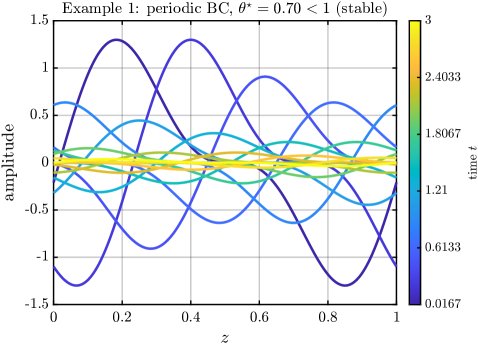
没有 dataset。评价方式是数学定理覆盖范围 + 示例验证 + 数值可解性展示。示例覆盖 transport PDE、time-delay sampled-data、boundary-controlled reaction-diffusion、switched-system reformulation,场景选择合理,能说明 abstract theory 确实能落到 PDE/Delay/PIE 问题上。
但 evaluation 支撑的是“框架可应用”,不是“数值方法优于现有方法”。PIE time-delay 示例中表格显示随着参数化阶数增加,LPI bound 逼近 monodromy stability limit;这更像 certificate-space scaling 的效果。文中没有系统比较 looped-functional、Wirtinger、input-delay 方法在同一任务上的保守性,也没有复杂工程系统或真机验证。
因此实验/示例对核心数学 claim 足够,但对 practical superiority 的支持有限。尤其 PIETOOLS 部分,benchmark 是否真正验证“低保守性”并不充分;它主要证明这些 operator inequalities 可被现有工具处理。
Limitation
1. 结构假设强。本文核心理论要求 time-invariant generator A 和 jump map J,且 jump 是 time-triggered。若 A(t)、J(t)、state-dependent impulse、memoryful feedback 或 sampled actuator dynamics 使 closed-loop 真正 time-varying,现有定理不能直接用。
2. Non-coercive sharpness 与 computability 分裂。Banach non-coercive 条件必要充分,但通常不是 convex program;coercive/quadratic 条件可计算,但在无限维 Hilbert 上可能只 sufficient。论文的理论最强部分和工程最可用部分并不是同一个对象。
3. Minimum dwell-time/unbounded dwell-time 下 semigroup stability 是硬前提,不是技术假设。只要允许 arbitrarily long no-jump interval,flow 本身必须 exponentially stable。很多想靠偶发 jump 稳定不稳定 PDE 的设定天然不适用 minimum dwell-time family,只能走 bounded/range/constant dwell-time。
4. Quadratic class 的上限明确。固定序列和 constant dwell-time 因为 monodromy 单例还能保必要性;任意、minimum、range family 涉及一族 monodromy,共同 quadratic operator 不足以刻画所有稳定情形。这不是小 conservatism,而是无限维结构性 gap。
5. 合成还没有解决。coercive dualization 给出了类似 LMI 的方向,但 constant gain reconstruction 与 timer-dependent dual variable 不兼容;文末也指出一般 hybrid feedback 会引入 time-varying closed-loop。也就是说,本文主要是 analysis theory,不是完整 stabilization framework。
6. 数值 scalability 未充分说明。PIE/SOS 参数化阶数提高会改善结果,但复杂 PDE、多个 delay、多输入边界控制时 SDP 规模如何增长,文中未充分说明。增益来源不清,可能主要来自更高阶 PI 参数化带来的 certificate scaling。
Takeaway
- 1. 这篇最值得记住的是 impulsive Datko Lemma:对无限维 hybrid evolution family,稳定性应由 flow-integral energy 和 pre-jump sequence energy 共同刻画。
- 2. Non-coercive Lyapunov functional 是无限维必要充分理论的正确对象;coercive/quadratic 是为了计算和合成而引入的附加结构,不能混同为一般 converse。
- 3. Dwell-time family 的本质是 admissible future set 的变化。
- constant dwell-time 是 monodromy;minimum dwell-time 强制 flow 自身稳定;range dwell-time 允许 flow 不稳定但要求所有 admissible periods 的 hybrid product 稳定。
一句话总结
这篇论文把无限维脉冲系统稳定性从传统 coercive quadratic/operator Lyapunov 框架中解放出来,用“积分 + 跳前求和”的 impulsive Datko 机制建立了 Banach 层面的 sharp 非 coercive 理论,并将其在 Hilbert/PIE 场景下投影为可计算但更保守的 operator 条件。