精读笔记
Problem Setting
题目是《A Deep Second-Order Stochastic Residual Method for Fully Nonlinear Parabolic PDEs》(arXiv preprint / 2026-07-21)。论文面对的是高维全非线性抛物 PDE,非线性项显式依赖 Hessian。这里的关键矛盾是:Hessian 是最难稳定、最难泛化、最容易被噪声放大的通道,但全非线性 PDE 的反馈恰恰通过 Hessian 进入 driver。
以前的深度 PDE solver 大多能较自然处理 value 或 gradient;一旦 driver 依赖 D2u,就会出现两个问题:一是学习目标的小 residual 不一定意味着 Hessian 对;二是递归式方法会把 Hessian 误差沿时间传播,稳定性分析很难闭合。本文实际要解决的不是“训练一个网络求 PDE”,而是证明一个 L2 stochastic residual objective 真的能控制 full jet。
Motivation
已有路线的缺口很明确。PINN/DGM 类方法最小化 PDE residual,但通常缺少 Hessian-dependent fully nonlinear 场景下从 residual 到 full-jet error 的稳定性结论;Deep 2BSDE/DBDP 有二阶通道,但依赖时间递推或局部回归,理论上难以避免误差传播;Deep Picard 类方法需要 source operator contraction,而全非线性 Hessian feedback 下该 contraction 本身就不是显然的。
作者的核心观察是:如果训练 objective 是 Brownian 路径上的 L2 residual,那么理论也必须在同一个 Brownian occupation law 下工作。传统 monotone scheme 的 L∞ deterministic defect 稳定性不能直接解释 learning loss。缺的不是一个新的网络模块,而是一个把 population L2 residual 变成 full-jet control 的稳定性框架。
Core Idea
D2SRM 的本质是把全非线性 PDE 的二阶结构编码进 Brownian one-step residual,并强制 value、gradient、Hessian 来自同一个 scalar space-time function。这个 derivative-consistency 是核心 inductive bias:网络不能任意拼出三个互相不兼容的通道,Hessian 也不是独立 latent process,而是同一函数的二阶导数。
理论上,它把问题分成两层:连续层面先证明 source-to-full-jet 的 occupation stability;离散层面再证明 Markov residual 到隐式 reference scheme 的 mesh-uniform stability。这样 residual 不只是训练信号,而是一个可认证的误差代理。和 prior 的本质区别在于,它不是沿时间递归传播解,也不是直接点态匹配 PDE residual,而是通过 Brownian chaos residual 在全局时间上联合约束 full jet。
Method
第一,Brownian occupation formulation 解决的是理论范数与训练采样分布不一致的问题。PDE 解被看成 Brownian 路径访问分布下的 mild object,而不是全空间 uniform object;这让高维 Monte Carlo 训练和误差分析落在同一 measure 上。
第二,single scalar network 解决的是 jet 不一致问题。Y=U, Z=∇U, Γ=D2U 同源,减少了独立学习 Hessian process 的自由度。这个约束牺牲了一些表达灵活性,但换来结构一致性,是方法能解释 residual 的关键。
第三,second-order Brownian residual 解决的是 Hessian 可观测性问题。Q_i=ΔW_iΔW_i^T-hI 抽取二阶 chaos,使 Hessian 通过随机一步展开进入 loss。这里不是 full Hessian supervised learning,而是通过路径增量的二阶统计识别 Hessian。
第四,terminal value 和 terminal gradient penalty 解决的是反向问题的边界锚定。只约束 terminal value 不够,因为 Hessian 稳定性链条里 gradient terminal norm 会进入常数;terminal H1 控制是理论必要项,不只是训练 trick。
第五,implicit reference scheme 解决的是 a posteriori reliability 的桥接问题。作者没有直接从 neural residual 跳到 PDE 解,而是插入一个隐式 Markov scheme,先证明 residual 控制到 scheme,再证明 scheme 接近 continuous target。
Key Insight / Why It Works
最核心的技术 insight 是 Gaussian affine-complement coercivity:在 Brownian occupation law 下,去掉 affine mode 后,Gaussian divergence operator 可以用 Hessian 控制。这给出了 source-to-Hessian estimate,常数中出现 2√2,并直接导致 Hessian coupling small-gain 条件。换言之,方法能成立不是因为网络强,而是因为 Brownian Gaussian 结构给 Hessian recovery 提供了一个特殊 coercivity。
第二个关键点是 centered-gradient identity。Hessian control 不是从 PDE residual 的点态二阶导数直接来,而是从 gradient semimartingale 的二次变差和 Gaussian integration by parts 来。这解释了为什么 terminal gradient penalty 是必需的:它进入 Hessian estimate 的 terminal energy。
第三个关键点是 Markov/local class。文中明确给出反例说明 arbitrary adapted path-dependent triple 下 residual small 不控制 Hessian。这个限制很重要:D2SRM 的稳定性不是一般二阶 BSDE residual 的稳定性,而是 state-local Markov residual 的稳定性。Deep 2BSDE 类型的 forward accumulated process 因此不自动落在理论范围内。
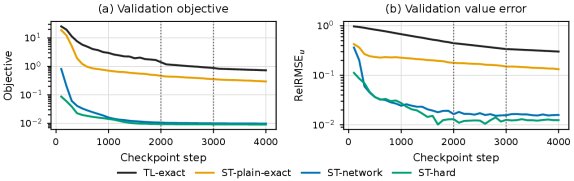
第四,可能真正带来工程效果的是 representation alignment 加上全局时间联合训练。ST-network/ST-hard 明显优于 time-layer/exact 替换,说明连续 time-space function 的 temporal coherence 比参数量更关键。这里增益不应归因于简单 scaling;TL-exact 参数更多但更差。
但也要直说:实验中 manufactured solution 很强,terminal hard constraint 和已知 ∇g 属于相当强的 supervision。full-Hessian error 的改善是否来自 residual 自身、terminal treatment、连续参数化,还是 benchmark 的低秩正弦结构,文中未充分说明。超出 small-gain 后 residual 仍低但 jet error 变坏,说明 loss informativeness 的理论边界不是形式问题,而是真实风险。
Relation To Prior Work
它最接近四条线:PINN/DGM residual minimization、Deep Picard/source iteration、DBDP/local regression、Deep 2BSDE 二阶随机系统。表面上 D2SRM 像 residual method,因为它直接最小化全局 stochastic residual;但本质上更像把 Picard/source stability、二阶 BSDE chaos 展开和 neural derivative consistency 组合到一个 population learning objective 中。
和 PINN 的差别在于 residual 不是 deterministic PDE residual,而是 Brownian one-step residual,且理论证明的是 Brownian occupation full-jet reliability。和 DBDP 的差别在于它不做 backward local solves,而是全时间联合优化,因此更并行,也避免逐步 tolerance 传播;但它把困难转移到全局非凸优化和 population approximation。和 Deep 2BSDE 的差别在于 D2SRM 强制 Markov state-local sampled jet,而 Deep 2BSDE 的 forward recursion 通常会引入 path dependence。
实质创新在稳定性链条,而不是网络架构。Gaussian affine-complement coercivity、first-interval Hessian averaging、endpoint-inclusive Copson estimate、mesh-uniform residual stability 这些是本文真正新增的信息。所谓方法本身可以看成已有思想的重组,但这套重组第一次把 Hessian-dependent fully nonlinear PDE 的 L2 learning objective 和 full-jet error 控制比较完整地接起来。
Dataset / Evaluation
实验覆盖很窄:100 维 manufactured benchmark,solution 是两项 sinusoidal modes,driver 人工构造以匹配 exact solution。它验证的是机制 sanity:loss 可下降、terminal treatment 重要、Hessian coupling 增强会削弱 residual 对 jet 的指示性、时间步减小时误差整体下降。
它没有验证真实控制问题、金融/博弈/HJB 场景、非恒等扩散、多初值分布、复杂 boundary、非 manufactured data,也没有 finite-sample generalization。benchmark 低维结构嵌在 100 维空间中,可能让网络实际学习的是低秩正弦组合;因此不能把结果解释成“解决一般 100 维 fully nonlinear PDE”。
实验最有价值的观察反而是负面的:在 small-gain 外 residual 还能低,但 jet error 上升,说明低 residual 不等于 Hessian 正确。这个现象支持作者关于 L2 stability regime 的谨慎态度。
Limitation
第一,理论依赖 identity diffusion 和 Brownian occupation law。Appendix F 给了一般扩散的条件性估计,但不是完整 D2SRM theory;离散 consistency、stability、sharp dimension dependence 都没有闭合。
第二,small-gain 条件很强。对 f(γ)=a∑|γ_jj|,L2=a√d,因此要求 a<1/√(8d),比 monotone scheme 可处理的 regime 严很多。这不是技术细节,而是当前 L2 residual framework 的上限。
第三,population-level 分析绕开了最难的三件事:有限样本泛化、SGD 优化、神经网络定量近似率。qualitative attainability 不说明需要多少宽度、多少样本、多少 Hessian-vector/coordinate derivative 计算。
第四,方法依赖 terminal gradient 可评估。很多真实 PDE 问题里 g 的 weak gradient 点值或 Hessian-related terminal regularity 并不方便,terminal H1 penalty 可能成为额外监督假设。
第五,scalability 仍受 Hessian channel 约束。训练中可用 directional second derivative 避免 materialize full Hessian,但 driver 若依赖 coordinate diagonal 或更一般 Hessian functional,仍可能有 O(d) 或更高成本。对真正复杂 Hessian nonlinearity,计算上限文中未充分说明。
第六,泛化 claim 目前主要是理论范数内的 population convergence,不是跨 PDE、跨初值、跨 state law 的泛化。方法可能只是把全空间难题转移到 Brownian occupation distribution 下;rare states 或 control-induced alternative laws 不受保证。
Takeaway
- 1. 这篇最值得记住的是:对 Hessian-dependent PDE,learning residual 是否可靠取决于 residual norm 与 Hessian stability 是否匹配;L2 Brownian residual 需要专门的 full-jet stability theory,不能直接借 monotone scheme 的 L∞ 直觉。
- 2. 单个 scalar network 生成 full jet 是强 inductive bias。
- 对 PDE learning 来说,representation alignment 比堆更多独立 heads/processes 更重要,尤其在二阶通道上。
- 3. Gaussian/Brownian structure 是方法成立的核心资产,也是边界。
一句话总结
D2SRM 是一篇把 Hessian-dependent fully nonlinear PDE 的 deep residual learning 从经验算法推进到 population full-jet stability 理论的论文,真正贡献在 Brownian occupation 下的二阶 residual-to-Hessian 控制,而不是网络架构本身。