精读笔记
Problem Setting
本文实际处理的是 UC 非凸市场定价中两个理论体系的对齐问题:CHP 从 convexified value function 的 subgradient 出发,CDP 从 CPP/COP reformulation 的 dual multipliers 出发。真正困难点不在于 UC MILP 本身,而在于 demand perturbation 究竟通过哪个 value function 被感知,以及 dual multiplier 是否真的是该 value function 的边际价格。
传统 CHP 卡在 per-generator convexification:它给出可分解、可解释的 decentralized price,但只凸包化每个机组的 feasible set,再用 demand balance coupling 汇总。这不是 full UC feasible set 的 convex hull,因此它和 centralized value function 的边际敏感性之间存在结构性偏差。CDP 另一边的问题是,它的 dual multipliers 包含 lifted constraints,哪些 multiplier 应该被称为“价格”并不自动清楚。
关键矛盾是:市场希望一个 uniform linear price,但 full nonconvex UC 的真实边际值可能包含由 lifted quadratic/RLT 结构产生的项。若只看 balance multiplier λ,会丢掉一部分 convex hull value function 的 sensitivity;若加入 lifted term,又会偏离传统线性电价解释。
Motivation
已有路线不够的地方在于,CHP 和 CDP 都声称处理 nonconvex pricing,但它们的 price object 没有被放到同一个 value-function 框架下比较。CHP 文献中的 decentralized convex hull price 是有意牺牲 centralized exactness 换取分解性;CDP 文献中的 copositive price 则有多个变体,尤其 marginal form 与 revenue-adequate volumetric form 容易混淆。
作者的核心观察是:如果把 CHP 重新定义在 joint feasible set 上,而不是按 generator 分别 convexify,那么 Burer 的 CPP 正好给出这个 full convex hull 的 lifted representation。于是 CDP dual 不只是另一个 pricing heuristic,而可以被看作同一个 UC value function 的 dual sensitivity。
关键缺口是“centralized convex hull price 的代数表达”。传统 convex hull price 很难直接从 full conv(X_UC) 的约束中读出 dual variable,因为 demand 如何进入 full convex hull 描述并不显式。CPP/COP lifting 刚好把 demand 的线性约束和平方 RLT 约束显式化,从而暴露出 price 中的 λ 与 Λ 两部分。
Core Idea
论文真正的核心是改变 convex hull pricing 的参照对象:不是传统的 ∏_g conv(X_g) 加 demand balance,而是 conv(X_UC(d)) 本身。这个改变看似只是 centralized vs decentralized 的定义差异,但它让 CHP 和 CDP 落到同一个 value function 上。只要 CPP feasible set 投影等于 original MILP feasible set 的 convex hull,COP dual 的最优值就与 UC value function 一致;价格自然应该从该 dual objective 对 demand 的敏感性读出。
直觉上,RLT squared demand constraint Tr(h_t h_t^T X)=d_t^2 捕捉了 demand balance 在 lifted moment space 中的约束效应。对 d_t 求导时,线性 balance 给 λ_t,平方 balance 给 2d_tΛ_t。因此 marginal CDP price 必须是 λ_t+2d_tΛ_t,而不是单独 λ_t,也不是 revenue-adequate scheme 中的 λ_t+d_tΛ_t。本文最本质的区别就在这里:它把 copositive price 解释为 exact centralized convex hull value function 的边际值,而不是普通 balance shadow price。
Method
1. Centralized CHP:解决传统 decentralized CHP 不是 full UC convex hull 的问题。它直接把价格定义为 v(d) 的 subgradient。这样 price object 更干净,但牺牲了传统分解结构,也让计算表达变难。
2. CPP/COP reformulation:解决 full convex hull 难以显式描述的问题。Burer reformulation 用 completely positive cone lifting 把 MILP 的 convex hull 投影表示出来,并通过 copositive dual 得到同一 value function 的 dual representation。核心变化是 demand 不只出现在原始 balance constraint,也出现在 lifted squared balance constraint。
3. Lagrangian sensitivity:解决“哪个 dual multiplier 是价格”的问题。对 saddle-point Lagrangian 关于 d_t 求导,得到 λ_t+2d_tΛ_t。这个步骤是全文的关键机制,因为它把 CDP multiplier 组合和 CHP subgradient 精确对齐。
4. Differentiability condition:解决多重最优 commitment transition 下价格不唯一的问题。若 value function 可微,CHP 和 marginal CDP 唯一一致;若不可微,两者可能选到不同 one-sided subgradient,但仍属于同一个 subdifferential 结构。
5. Decentralized COP/SDP:解决传统 decentralized CHP 如何放进同一 copositive 语言的问题。按 generator 分别 lifting 后,跨机组 demand-RLT constraint 不存在,因此 Λ 项消失,价格退化为 λ_D。这说明 centralized 和 decentralized 的差异不是记号差异,而是 lifted coupling 信息是否存在。
Key Insight / Why It Works
最重要的 insight 是:CDP 中真正对应 convex hull marginal price 的不是 demand-balance dual λ,而是包含 lifted demand constraint 的 sensitivity λ+2dΛ。这个 2dΛ 项不是 engineering trick,而是由 RLT lifting 后 value function 对 demand 的二次显式依赖强制产生的。忽略它就会把 CDP 误读成普通 LP shadow price。
方法有效的原因在于它没有试图近似 convex hull 的 facet description,而是通过 CPP 的 projection theorem 绕过显式 convex hull 描述。对 full UC feasible set 而言,conv(X_UC) 很难写;但 CPP feasible region 的 x-projection 等于该 convex hull。于是 exact CHP 的 value function 可以通过 COP dual 间接表达,price 则通过 dual objective sensitivity 得到。
最可能的核心贡献是 centralized CHP 与 marginal CDP 的 equivalence characterization,尤其是把 λ+2dΛ 与 subgradient 绑定。SDP restriction、Scarf example、decentralized COP 重写更像辅助:它们帮助说明 exact result 与传统 practice 的关系,但不是主要技术增益。
这不是 scaling 论文,也不是 better engineering。它本质上是 representation alignment:把 CHP 的 primal convex hull view 与 CDP 的 lifted conic dual view 对齐。所谓更 tractable 的 SDP 部分只是把不可计算 COP 换成较弱 inner approximation,增益来源不清,且无法保证真实市场规模下 gap 可控。
Relation To Prior Work
最接近的两条线是 Hogan/Gribik/Hua-Baldick 系列的 convex hull pricing,以及 Guo-Bodur-Taylor 的 copositive duality pricing。本文不是提出第三种 pricing scheme,而是给出两条线之间的 exact correspondence。
和标准 CHP 的本质差异在于 convexification 的对象。标准 decentralized CHP 是 ∏_g conv(X_g) 后再平衡需求,保留机组分解性;本文 centralized CHP 是 conv(X_G ∩ H(d)),即先施加联合可行性再凸包化。这个顺序差异直接决定是否存在 lifted demand term。
和已有 CDP 的差异在于价格解释。Guo-Bodur-Taylor 中有 revenue-adequate volumetric price λ+dΛ;本文强调若目标是 marginal value / CHP equivalence,则必须是 λ+2dΛ。这个 factor-of-2 是一个小但关键的理论区分。
看似新的 decentralized copositive formulation,其实更像已有 per-generator convex hull 思想的 conic 重写。实质创新在 centralized full-hull characterization 和 lifted sensitivity decomposition。
Dataset / Evaluation
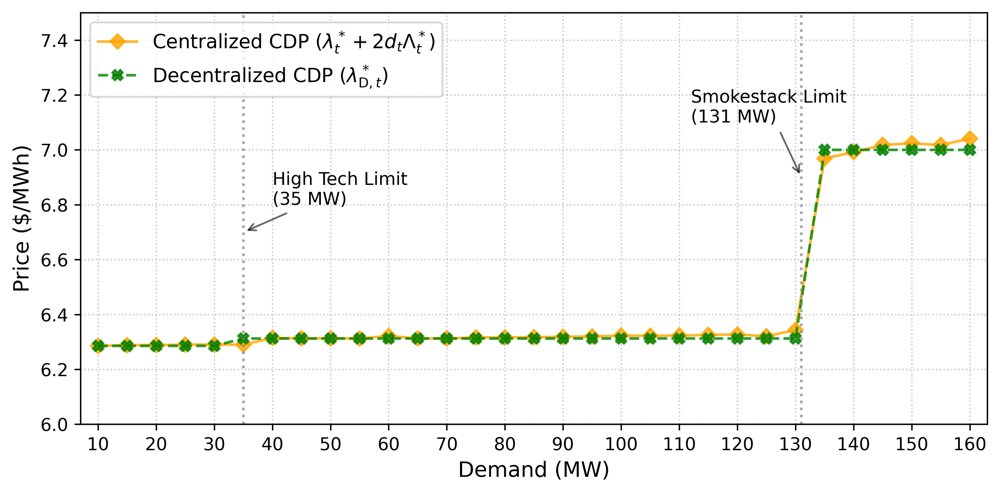
实验使用 modified Scarf example,需求从低到高扫描,比较 centralized CDP、decentralized CHP/CDP、SDP-restricted variants 以及 uplift。这个 benchmark 适合展示 nonconvex pricing 的典型 commitment transition,也足够验证几个价格定义在简单场景中的相互关系。
但 evaluation 只能支持“理论关系在一个标准 toy example 中数值一致”这一层 claim。它没有验证大规模 UC、网络约束、多时段复杂 constraints、真实市场数据、solver robustness 或 cone approximation hierarchy 的性能。Scarf example 更像 controlled illustration,不是 evidence of deployability。
实验中 decentralized prices 基本一致,transition 点出现差异,这和 subgradient 非唯一的理论相符。centralized price uplift 更低/不同的解释也提示:不同 uplift definition 下结论会变。文中未充分说明这些价格在真实 settlement rule 下应如何落地。
Limitation
最大限制是 exact result 依赖 COP,而 copositive optimization 本身不可计算;实际可用的是 SDP restriction,但 SDP restriction 只是内近似,v_SDP≤v,gap 何时小、价格何时可信,文中没有给出可推广条件。
第二个限制是 centralized price 的经济解释并不干净。λ+2dΛ 是 marginal value 的数学对象,但 Λ 来自 squared lifted constraint,不是传统 market-clearing balance 的 shadow price。它是否能作为实际 uniform linear energy price,或者是否应被视为 nonlinear/lifted settlement component,文中未充分说明。
第三,value function 在 commitment transition 处不可微,而这些点在 UC 中恰恰有市场意义。论文用 measure-zero 解释数学上成立,但实际需求、报价和离散容量经常把系统推到这些边界附近。此时价格选择、one-sided derivative、subgradient selection 会影响 uplift 和 incentives。
第四,实验规模太小。没有证据说明 SDP-restricted price 在真实系统上接近 exact COP price;也没有证据说明 centralized formulation 的计算或解释优势能超过 decentralized CHP。这里的增益主要是理论澄清,不是可扩展算法突破。
Takeaway
- 1. CHP 与 CDP 的关系应通过 value function sensitivity 理解,而不是通过表面上的 dual variable 名称理解。
- 真正的 marginal CDP price 是 λ+2dΛ。
- 2. centralized vs decentralized CHP 的差异不是实现细节,而是 convexification 顺序差异:full joint convex hull 会保留跨机组 demand lifting 信息,per-generator convex hull 会丢掉这部分信息。
- 3. Copositive reformulation 的价值在这里主要是理论语言:它给 full convex hull price 一个代数刻画。
一句话总结
这篇论文把 convex hull pricing 和 copositive duality pricing 统一为同一个 UC value function 的次梯度刻画,真正贡献是指出 exact centralized marginal price 必须包含 lifted demand term λ+2dΛ,而不是提供一个可扩展的新定价算法。