精读笔记
Problem Setting
这篇论文的真实问题不是“如何让 MPPI 自适应噪声”,而是:在已有 MPPI 闭环稳定性证书中,未知过程噪声协方差造成的 residual penalty 能否被在线学习并可证明地降低。关键困难是 MPPI 的采样协方差不是普通 exploration knob,它通过 σσ^T=λ_0(R^TR)^{-1} 和控制代价权重耦合;因此协方差估计错了,不只是 rollout 分布错了,控制强度和风险敏感性也同时错了。
以前路线卡在两个地方。固定 covariance 的稳定性分析只能接受一个 permanent mismatch penalty;RL/heuristic covariance adaptation 能改善行为,但把 σ 当控制参数,不给 convergence rate、steady-state error,也无法进入 Lyapunov bound。本文要解决的关键矛盾是:在线学习需要 transient exploration/estimation cost,但稳定性证书要求每一步的 perturbation 可控。
Motivation
作者的核心观察是:当 finite-sample MPPI error 已经由 rollout 数控制住以后,剩下真正限制 certificate tightness 的不是采样误差,而是 process covariance mismatch。也就是说,继续加 M 只能降低 Monte Carlo floor,不能消除噪声模型错配带来的稳定性地板。
已有 covariance adaptation 不够,是因为它通常服务于 policy improvement 或 exploration,而不是估计真实扰动统计量。缺的是一个能同时回答三件事的框架:估计器最终收敛到哪里、学习过程中的误差如何衰减、这个误差如何转化为闭环稳定性 bound 的可计算 penalty。本文就是把这个缺口显式化。
Core Idea
核心思想是把未知空间变化的扰动协方差场离散成 cell-wise statistical estimand,并用在线残差二阶矩估计它;同时加入空间扩散,让访问稀疏 cell 可以从邻近 cell 借信息。这里真正新的建模选择不是 cell discretization,而是 diffusion kernel 按 stationary visitation measure 设计,使信息共享和 Lyapunov 分析使用同一个加权几何。
直觉上它有效,是因为 closed-loop trajectory 的数据覆盖天然不均匀;如果不用扩散,rarely visited cell 的估计会慢且 noisy;如果用普通扩散,又可能在稳定性分析中引入非耗散项。stationary-measure-weighted diffusion 把“谁更常被访问”编码进估计器,使高访问区域的信息能以可证明不破坏收缩的方式传播。和 prior 的本质差异是:它不是学习一个更好的 MPPI tuning policy,而是学习 MPPI 稳定性证书里真正需要的统计对象。
Method
第一,online covariance estimator 解决的是局部噪声统计未知问题。每次观测到 x_{k+1} 后,用 nominal model residual 形成 \hat w_k\hat w_k^T,更新当前 cell 的 covariance estimate。这个机制的核心变化是把 adaptation 信号从 reward/performance feedback 换成 process residual statistics。
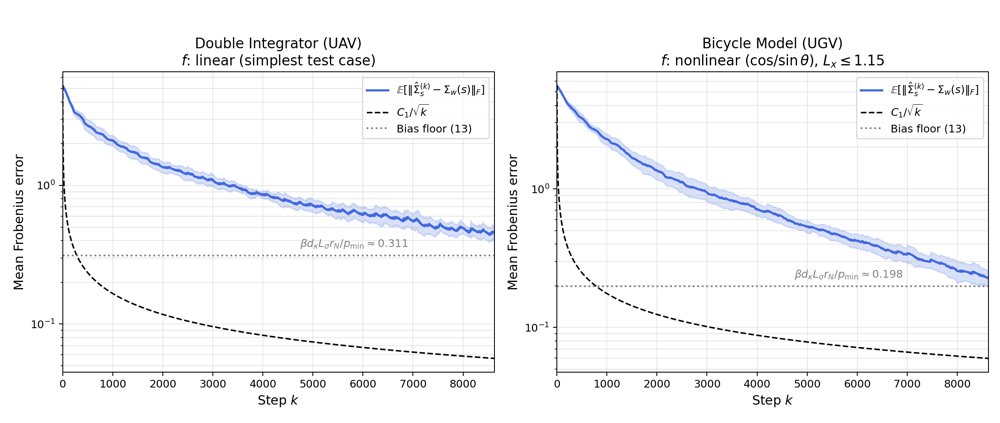
第二,spatial diffusion 解决数据覆盖不均。扩散项不是为了让环境变平滑,而是在空间 Lipschitz 假设下把邻域信息作为 inductive bias 注入估计器。代价是 smoothing bias,大小随 β、d_κ、L_σ、邻域半径和 1/p_min 增长。
第三,stationary-measure kernel 解决证明问题。选择 κ(s,s')=a_ss'/p_s 后,扩散算子在 p_s-weighted norm 下形成 Dirichlet energy,Lyapunov 分析中扩散项非正。没有这个结构,扩散可能破坏 stochastic approximation 的收缩。
第四,plug-in stability analysis 解决估计误差如何进入 MPPI certificate。估计误差一方面改变 MPPI control output,另一方面改变 noise floor;论文把二者合成 adaptation penalty ψ(k),并证明它由 SA error、smoothing bias 和 finite-horizon drift allowance 控制。
第五,payoff theorem 不是证明 adaptive 总是更好,而是给出条件化比较:当固定 covariance 的 mismatch 大于 adaptive 的 residual smoothing bias 加 drift allowance,并且两边都满足 contraction threshold 时,存在可计算 crossover time,之后 adaptive certificate 更紧。
Key Insight / Why It Works
最核心贡献是把 diffusion kernel 的可逆性 / detailed balance 和 Lyapunov norm 对齐。这个点比 estimator 公式本身重要。cell-wise sample covariance 是标准随机逼近,空间平滑也是常见操作;真正让论文成立的是:扩散不是任意 regularizer,而是被设计成在 closed-loop visitation measure 下 dissipative,因此可以和 SA 收缩放进同一个证明,而不需要 two-timescale machinery。
方法有效的主要来源是 better inductive bias 加 data coverage reuse。它不是 scaling:rollout 数增加只能降 MPPI approximation error,不能解决 covariance mismatch。它也不是 retrieval 或 hidden supervision;统计信号来自真实 residual。它更像 test-time system identification 被嵌进控制器,并且通过空间先验提升低访问区域的样本效率。
最可能是核心贡献的部分:stationary-measure-weighted diffusion 的 fixed-point bias bound、SA error / smoothing bias / drift decomposition、以及把估计误差转成 stability penalty 的 payoff theorem。较辅助的部分是具体 MPPI sensitivity Lipschitz bound;它必要但保守,更多是为了把估计误差接入 companion certificate。
需要直接指出的是,实验里的 closed-loop reward 增益归因不干净。作者自己承认准确 covariance 不等于 reward-optimal covariance,因为 Σ_ε 同时控制 exploration radius。Table 中 adaptive 甚至超过 oracle,这不是说明 estimator 比 oracle 好,而是说明任务 reward 和 stability-bound calibration 是两个目标。若只看 task performance,增益可能主要来自改变 sampling radius 的 optimization effect,而不是噪声估计本身。
Relation To Prior Work
最接近的路线有三类:path-integral / MPPI covariance adaptation、MPC/filtering 中的 noise covariance estimation、以及 stochastic approximation with diffusion。与 PI2-CMA 或 risk-sensitive MPPI 的差别在于,这里 covariance 不是 policy improvement 的 exploration parameter,而是 disturbance covariance 的统计估计量;更新 Σ_ε 的同时更新 R,保持 path-integral coupling constraint。
和传统 MPC noise covariance estimation 相比,本文不是离线 batch identification,也不只服务于滤波器调参,而是在线进入 sampling-based nonlinear controller,并且要把误差传入闭环稳定性证书。
看似新的部分中,cell discretization、sample covariance recursion、spatial smoothing 都不是新思想;实质创新在于把这些已有组件组织到 MPPI 稳定性接口里,并通过 stationary visitation measure 让 smoothing operator 与 Lyapunov proof 对齐。它属于“certified adaptive control / online system identification for sampling-based MPC”谱系,而不是单纯 MPPI engineering。
Dataset / Evaluation
Evaluation 覆盖两个模拟环境:double integrator UAV 和 bicycle UGV,噪声场空间变化,有静态场和慢变化场。它能支持的核心 claim 是有限的但基本对位:estimator error 确实下降,bias floor 和 payoff crossover 的趋势被展示,stationary-measure kernel 相比 uniform kernel 有一定优势。
但实验没有真实机器人、没有高维复杂系统、没有大规模跨任务评估。更重要的是,task reward 实验并不能严格验证 stability bound tightening,因为 reward 受 MPPI exploration radius 强烈影响。作者对这一点比较诚实:oracle true covariance 不一定 reward 最优,说明评估中 performance improvement 不能简单归因于更准确的 disturbance covariance。
因此,实验更像 proof-of-mechanism,而不是强 deployment validation。它验证了理论量的方向性,但没有证明该方法在真实复杂 MPPI 应用中一定带来任务收益。
Limitation
第一,persistent excitation 假设很强。p_min>0 意味着所有 cell 都要被持续访问;一旦任务是单程导航或大状态空间稀疏访问,估计器在未访问区域没有统计基础,d_κ/p_min 项会直接爆炸。
第二,scalability 受 cell discretization 限制。高维状态下 cell-wise covariance field 很快不可行;论文没有解决 representation learning 或 function approximation 版 covariance estimator。
第三,p_s 需要已知或预估。文中未充分说明 p_s 估计误差如何破坏 detailed balance、dissipativity 和 fixed-point bias。实际 deployment 中 closed-loop policy 又会随 estimator 改变,stationary visitation measure 本身不是固定对象。
第四,time variation 只在 finite horizon 上处理。由于 step size diminishing,面对持续 non-vanishing drift 不可能有稳定 asymptotic tracking floor;论文给出的 C_v ε_v T 是诚实但保守的有限窗口 allowance。
第五,stability certificate 有硬 threshold。若 early estimation error 使 δ_adapt 超过 contraction robustness threshold,则 adaptive controller 没有证书;这不是小技术条件,而是部署前必须检查的前提。
第六,方法把一部分问题转移到了 coupling constraint 的结构矛盾上:Σ_ε 既是噪声模型又是 proposal covariance。准确估计 Σ_w 可以收紧 stability bound,但可能降低 optimization exploration 或 obstacle avoidance。所谓 adaptive improvement 在 reward 上可能主要来自 sampling-scale effect,而不是统计校准。
Takeaway
- 1. 这篇真正推动的是把 MPPI covariance adaptation 从 heuristic tuning 拉回到 statistical estimation plus stability certificate,而不是提出一个更强的 MPPI controller。
- 2. 最可迁移的 insight 是:如果在线估计器带空间信息共享,kernel 不能只按直觉设计;它必须和闭环数据分布以及 Lyapunov norm 对齐,否则 smoothing 会成为证明里的不受控扰动。
- 3. 对 adaptive control 来说,learning transient cost 应该显式进入 stability bound,并与 fixed mismatch 的 permanent cost 比较;crossover time 比“最终收敛”更接近 deployment 问题。
- 4. 未来真正值得做的是 function-approximation covariance fields、带主动探测的 visitation design、p_s 不确定性分析,以及把“统计噪声模型”和“MPPI exploration covariance”解耦或联合建模。
一句话总结
这篇论文是 MPPI 稳定性理论链条中的 noise-adaptive 一环,核心贡献不是更好的实验性能,而是用 stationary-measure-weighted spatial smoothing 把在线协方差估计误差可证明地转化为会衰减的稳定性 penalty。