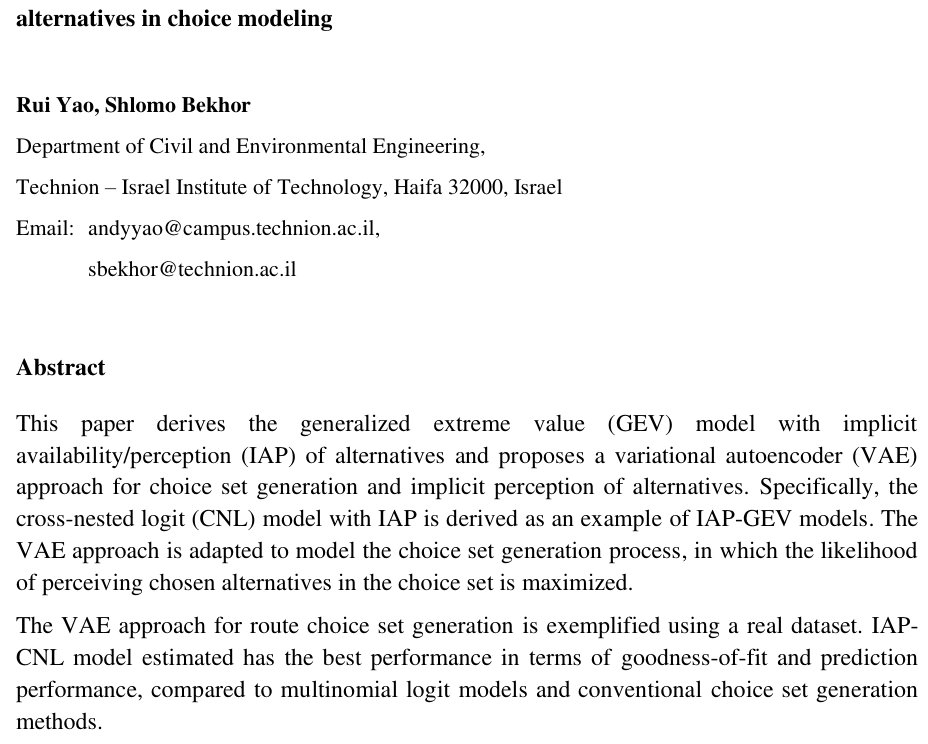
精读笔记
Problem Setting
这篇论文实际解决的不是“如何用 VAE 生成路线”这么表层的问题,而是大规模 choice modeling 中 choice set 不可观测、不可枚举、且错误指定会污染 utility coefficient 的结构性问题。
核心矛盾在于:估计 discrete choice model 需要一个可用于归一化的 candidate set,但真实决策者感知到的集合既不可见,也不等同于物理可行集合。若用小规模 deterministic subset,可能漏掉关键 alternatives;若假设 full choice set,又在 route choice 这类任务上行为上很弱;若用 sampling correction,又更像 modeler-side sampling fix,不一定解释 individual perception。
以前方法卡在两个地方:alternative generation 依赖手工规则或随机游走,choice set formation 的 probabilistic 部分又通常被简化成低容量 IAP 形式。本文试图把这两个环节统一为一个 learned perception distribution:既生成候选项,又给候选项一个被感知的强度。
Motivation
作者的核心观察是:我们虽然看不到个体真正考虑过哪些 alternatives,但至少能看到最终被选的 alternative;被选项必须属于其感知集合,因此 chosen alternatives 是 perception process 的有偏但有用样本。
已有路线缺的是一个足够灵活的 choice set formation model。Cascetta/Papola 的 IAP 给出了 fuzzy availability 的入口,但 IAP 的函数形式简单;link penalty、k-shortest path、branch-and-bound 等生成方法则需要事先定义 route search criterion。作者想补的缺口是:不要先手工定义“什么路线可被感知”,而是从 observed chosen route attributes 中学习一个 latent generative model,再把它转成 IAP。
这个动机是合理的,但也埋下了一个重要前提:chosen alternatives 的经验分布必须足够覆盖感知空间。否则 VAE 学到的不是 perception,而是被选择后的 revealed distribution,里面混有 preference、network supply 和 OD structure。
Core Idea
核心思想是把 choice set generation 从“搜索可行 alternatives”改成“学习 alternatives 被感知的生成分布”。VAE 的 encoder 把 observed chosen alternative 映射到 latent representation,decoder 从 latent space 生成新的 alternative attributes;同时用 importance-weighted estimator 近似 log perception probability,并把它作为 ln BC_n(j) 放进 choice probability。
理论上它可能有效,是因为它把原先很难直接建模的 choice set formation 变成 density estimation:如果 observed chosen alternatives 是 perception distribution 的样本,那么能高概率重构/生成这些 alternatives 的模型,也能给相似 alternatives 更高 IAP。这样生成的 choice set 不再只是网络拓扑搜索结果,而是带有 data-driven behavioral prior 的候选集合。
和 prior 的本质区别不是“用了 neural network”,而是信息流变了:传统方法先生成 choice set,再估计 choice model;本文让被选 alternatives 的属性分布反过来塑造 candidate set 和 availability weight。它引入的 inductive bias 是 latent route-characteristic clusters,而不是 link-level overlap 或 shortest-path perturbation。
Method
第一,IAP-GEV / IAP-CNL 推导解决的是 fuzzy availability 如何进入非 MNL 的相关替代项模型。作者不是简单把 ln BC 当作 utility covariate,而是把 BC 放进 CNL generating function,使其影响 nest 内归一化结构。核心变化是 IAP 不只修正单个 alternative 的 utility,也影响 CNL 中相似 alternatives 的竞争结构。
第二,VAE 解决的是 IAP 函数无法手工指定的问题。真实 q*(j) 不可见,作者用 latent variable z 分解复杂分布,用 encoder 近似 posterior,用 decoder 近似 conditional generation,再用 importance-weighted lower bound 估计 log q_theta(j)。机制上,这是把 choice set formation 变成 learned density / likelihood scoring。
第三,在 route choice 应用中,decoder 生成的是 route characteristic attributes,而不是直接生成网络路径。这个设计降低了生成难度,也让 latent z 可以解释为 route clusters / CNL nests。但这也意味着方法没有完全解决 feasible route generation,只是把问题转移到属性空间,再通过外部 route realization 找真实路径。
第四,IAP-CNL 把三件事耦合起来:生成候选项、估计候选项被感知概率、用 latent membership 表达 alternatives 相似性。这个耦合是论文最有价值的机制,而不是具体的 FC layer、Tanh、batch size 或 random search。
Key Insight / Why It Works
最可能真正有效的部分,是用 observed chosen alternatives 学到一个比 link penalty 更贴近经验选择分布的 candidate generator。对 route choice 来说,传统 link penalty 生成的是“网络上合理”的路径,但不一定是“人会感知/会选”的路径;VAE 生成的是 chosen-route attribute manifold 附近的 alternatives,因此更容易覆盖测试集中被选择行为相关的区域。
这更像 data coverage + representation alignment,而不是强意义上的 generative reasoning。VAE 并没有理解路径规划,也没有直接建模 individual mental choice set;它学习的是 route attribute density。性能提升可能主要来自把候选集合限制在更相关的属性区域,同时用 IAP 对低密度 alternatives 降权。
IAP-CNL 的增益还有一部分来自更合适的 correlation structure。传统 link-nested CNL 用 link 作为 nests,结构庞大且稀疏;VAE latent clusters 给出更 compact 的 route-characteristic nests。这可能是 estimation/prediction gain 和 runtime gain 的重要来源。换言之,收益不一定来自 VAE 作为生成模型本身,而可能来自低维 latent clustering 替代高维 link nesting。
论文中“consistency”实验只能部分支持 claim。它说明 IAP misspecification 会影响 coefficient bias,也说明随机 VAE generation 在模拟设置下没有显著偏离 preset coefficients。但这个实验仍在作者生成机制和同一数据域内,不足以证明一般意义下的 consistent estimator。
需要直接指出:增益归因不清。VAE choice set、IAP correction、CNL latent nests、choice set size、attribute-space generation 与 train/test distribution overlap 同时变化。没有充分 ablation 去区分这些因素。论文的核心贡献应被理解为一个 plausible learned choice set formation framework,而不是已经严格证明 VAE 本身优于所有 route generation 机制。
Relation To Prior Work
它最接近三条线:latent choice set / probabilistic choice set formation,sampling of alternatives / correction terms,以及 data-driven route choice set generation。与 Cascetta/Papola 的 IAP 模型相比,真正新增的是用 VAE 学 BC_n(j),并把 IAP 扩展到 GEV/CNL;与 Frejinger/Guevara 的 sampling correction 相比,本文强调 choice set 是 individual-side perception,而不是 modeler-side sampled subset;与 Yao & Bekhor 2020 相比,本文给了一个更系统的 latent generative formulation。
看似新的部分里,有不少是已有思想重组:fuzzy choice set 来自 IAP,latent constraints 来自 random constraints / latent choice set,CNL correlation 早已有,VAE likelihood estimator 来自标准 VAE/IWAE。实质创新在于把这些部件接到同一个 choice modeling pipeline 中:learned alternative perception distribution 同时用于 generation、availability scoring 和 nesting。
它属于“discrete choice model + learned representation / generative model”的谱系,但比一般 DNN choice model 更偏 structural:不是直接用 NN 替代 utility,而是让 NN 学不可观测 choice set formation。这一点比单纯提高 prediction accuracy 更有研究价值。
Dataset / Evaluation
Evaluation 使用 Tel Aviv GPS route choice 数据,是真实世界交通数据,不是纯 toy benchmark。任务覆盖集中在单一城市、单一模式、route choice 一个应用场景;没有跨城市、跨网络、跨时间或跨 OD 分布 shift 的验证。
实验主要支持两个 claim:VAE-generated choice set 在该数据域内比 link penalty choice set 更利于 estimation/prediction;IAP-CNL 比不带 IAP 或不建模相关性的版本更好。它没有充分验证更强的 claim:VAE 学到了一般化的 perception mechanism,或者该机制能在新网络/新群体上保持行为解释力。
另一个 evaluation limitation 是生成对象主要是 route attributes,而非直接可行路径。文中讨论了 fuzzy alternative realization,但这部分更像后处理建议,不是主实验的核心闭环。因此 benchmark 验证的是 attribute-level candidate generation + choice model performance,而不是完整 deployment 下的 end-to-end feasible route choice set generation。
Limitation
最大前提是 chosen alternatives 能代表 perceived alternatives。这个前提很强,因为 chosen route 是 perception 与 preference 共同筛选后的结果。若某类 route 经常被感知但很少被选择,VAE 可能低估其 IAP;若某类 route 因 utility 高而常被选,模型可能把 preference 错当成 perception。
IAP 与 utility coefficient 的识别关系不够清楚。BC_n(j) 以 ln form 进入 choice probability,本质上也在改变 alternative attractiveness;如果 IAP 由 chosen alternatives 学得,它可能吸收一部分原本应由 utility covariates 解释的偏好结构。文中未充分说明如何避免 perception model 与 choice model 之间的 confounding。
scalability 的上限不在 VAE 训练,而在 feasible alternative realization。生成属性向量很容易,但要在真实网络中找到满足这些属性、OD 可行且行为合理的路径,仍需 k-shortest path、link elimination 或 random walk。方法把最难的 combinatorial object generation 部分部分转移到了后处理。
泛化可能 heavily rely on data coverage。若训练 GPS 数据覆盖不足、OD pattern 改变、网络结构变化或出行者群体变化,latent route attribute manifold 可能失效。所谓 generalizable framework 在形式上成立,但实证泛化没有被充分证明。
增益来源不清。可能主要来自 scaling / data,即 VAE 利用大量 GPS chosen routes 学到了经验分布;也可能来自更 compact nests,或者来自 IAP 对不常见 alternatives 的降权。论文没有足够强的 ablation 来把这些归因拆开。
文中对 endogeneity 的处理说服力有限。作者用 normalized attributes 训练 VAE、absolute attributes 估计 choice model,并称这有助于避免 endogeneity,但这不是严格识别论证。perception 与 preference 的共同决定仍可能存在。
Takeaway
- 1. 最值得迁移的 insight 是:当 choice set 不可观测时,可以把 choice set formation 看成 learned density estimation,而不是手工 alternative search。
- 2. IAP 不应只被当作 utility correction;在 GEV/CNL 这类模型中,它可以进入 generating function,从而影响替代项相关结构。
- 这比简单加 ln BC 更结构化。
- 3. 对大规模 route choice,attribute-space generation 是一个务实折中:它牺牲了直接可行性,换来更好的 sample efficiency 和更紧凑的 latent structure。
一句话总结
这篇论文把大规模 choice set generation 从规则搜索推进到 learned fuzzy perception distribution,并把 VAE 作为 IAP-GEV/CNL 的生成与校正模块,是一次有价值的结构化重组,但其收益很可能主要来自数据覆盖、latent clustering 和 IAP 降权的组合。