精读笔记
Problem Setting
[Scaling Behavior Foundation Model for Humanoid Robots](arXiv preprint / 2026)
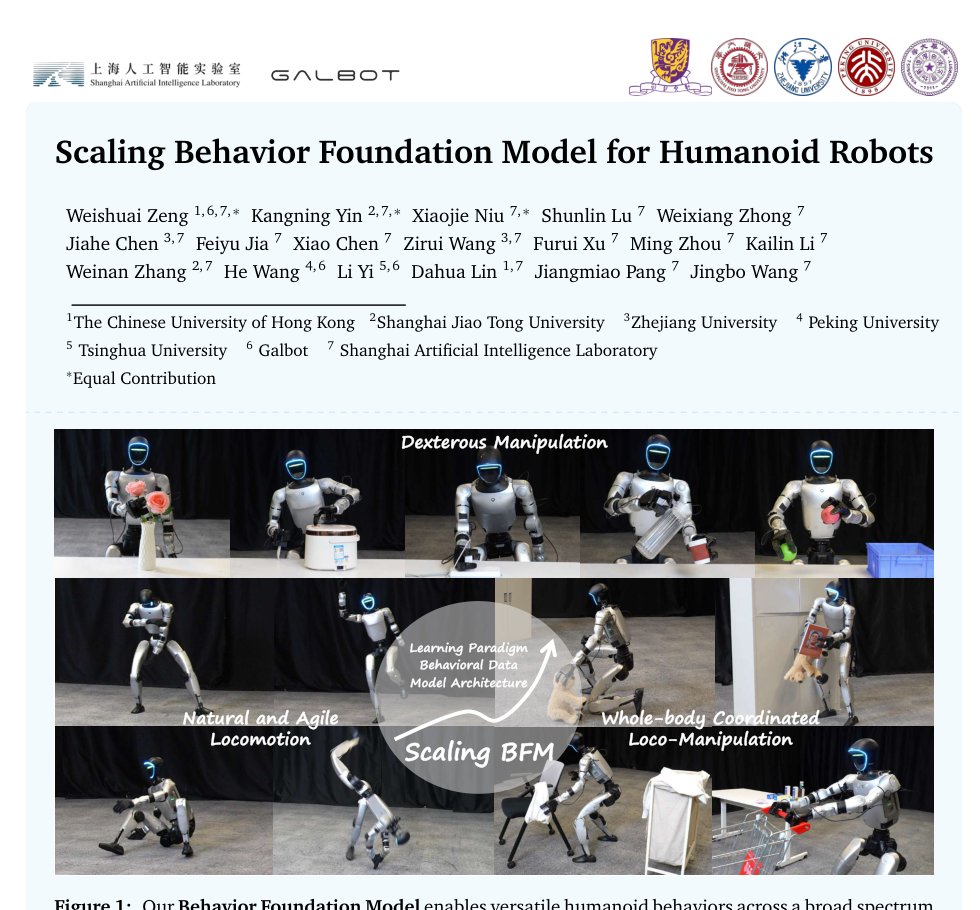
这篇论文实际在解决 humanoid BFM 的 scaling recipe,而不是提出一个新的单项运动控制器。目标是训练一个能接收多种行为 specification、输出实时低层动作的 foundation controller,使其可以覆盖 locomotion、manipulation、loco-manipulation 等不同全身行为。
真正困难点在于,humanoid whole-body control 的“行为”不是单个姿态或末端轨迹,而是 root motion、全身协调、接触动力学和时序意图的耦合结果。以前方法卡在两个地方:任务式 controller 依赖 reward engineering,难跨任务复用;motion tracker 虽然统一,但通常把完整 reference motion 当作唯一接口,泛化到稀疏控制或多模态规格时需要额外高层模块。BFM 的关键矛盾是:既要用 dense imitation 信号提高训练效率,又不能让模型被完整 motion reference 这个接口锁死。
Motivation
已有路线不够的地方不是“模型还不够大”这么简单,而是 scaling 的对象没有定义清楚。很多工作把 reference motion 数量当作 training data scale,但在 PPO 里真正参与更新的是 on-policy rollout;reference motion 更像行为分布的 generator。也就是说,数据数量和行为多样性是两个不同变量,混在一起看会得到误导性的 scaling 结论。
作者的核心观察是:BFM scaling 需要同时解决三个缺口。第一,学习范式要足够统一,不能为每个下游控制模式重新定义 reward。第二,行为数据要同时有 rollout quantity 和 reference diversity。第三,模型结构要能表达历史动力学与未来控制意图之间的条件关系,而不是只靠 MLP 把所有观测拼接后回归动作。
Core Idea
论文真正核心的思想是:把 humanoid BFM 预训练视为 global-frame whole-body behavior reproduction,而不是 local pose imitation。root trajectory 被纳入行为本体后,forward walking、in-place marching、turning、crouching 等行为不再在局部姿态空间里混叠。这个改动给模型引入了一个很强的 inductive bias:行为意图必须和全局位移、朝向演化、全身姿态共同解释,而不是只解释 root-relative skeleton。
另一个核心是用 masked whole-body target poses 统一多种控制模式。稀疏控制信号不再是下游 fine-tuning 的特殊情况,而是在预训练中就作为同一行为的不同观测视角出现。这样 BFM 学到的是从 partial specification 到完整 physically feasible behavior 的条件补全能力。相比 prior,它改变的不是单个模块,而是把“控制接口多样性”内化到 motion tracking 训练过程中。
Humanoid Transformer 的意义在于重新组织信息流:历史 proprioception/action token 负责闭环动态上下文,未来目标 token 负责控制意图,cross-attention 负责二者对齐。这个结构比 MLP 更适合表达“当前身体状态 + 未来多帧目标 + 控制模式 mask”之间的时序条件关系,因此在相同参数量附近更 scalable。
Method
方法可以压缩成几个机制。
第一,global integrated reward 解决行为语义歧义。以前去掉 root-position tracking 或把 root 与 pose tracking 拆开,会弱化全身行为的一致性监督。本文让 root evolution 和 body pose 一起被追踪,核心变化是把 reference motion 当作完整行为轨迹,而不是局部姿态模板。
第二,masked control interface 解决 specification 多样性。模型每个 episode 面对不同 activated links,包括 root、hands、feet、upper body、whole body 等。它不是在学八个 controller,而是在学同一行为 manifold 下不同观测子集到动作的映射。这是 behavior inpainting 的控制版本。
第三,on-policy rollout scale 与 reference diversity 被明确分工。增加 GPU 数和 rollout horizon 提升每次 PPO 更新的数据量与估计稳定性;增加 reference corpus 只有在扩大行为覆盖时才有意义。这一点比“更多 mocap 一定更好”的说法更准确。
第四,Transformer backbone 解决条件依赖表达。历史状态/动作序列提供短期动力学记忆,未来窗口提供 lookahead,随机 future offset 兼顾实时部署延迟。球面 latent 不是一个独立目标,而是通过结构约束让 goal embedding 更容易形成连续、可扰动的行为意图空间。
Key Insight / Why It Works
最可能的核心贡献是 global-frame integrated motion tracking 加上多控制模式 masked conditioning。前者让行为学习的监督信号更一致,后者让 BFM 在预训练阶段就学会从 sparse intent 恢复 full-body behavior。这两者组合起来,才使 motion tracking 从“单一控制任务”变成“行为基础模型的代理任务”。
on-policy scaling 的效果本质上主要是 PPO engineering / scaling:更大 rollout batch 改善 advantage/value/policy update 的统计质量,减少 noisy update。它重要,但不是新的行为建模 insight。reference motion scaling 的结论更有价值:不是 motion 数量带来能力,而是行为覆盖与测试分布相关性带来能力。换句话说,模型的泛化很大程度仍受 support coverage 限制。
Transformer 的增益更像 better inductive bias,而不是纯参数量收益。中等规模 Transformer 已经接近或超过更大 MLP,说明 tokenized temporal conditioning 比拼接式 MLP 更适合这个问题。但继续增大后收益不稳定,甚至不同 control mode 互相牵制,说明模型容量不是唯一瓶颈,shared latent / shared policy 下的多模式优化冲突可能已经出现。
latent space 的结果可以看作 representation alignment 的证据,但不应过度解读。可视化显示局部连续和方向组织,扰动实验显示一定鲁棒性;但这并不能证明模型学到了可组合的高层行为概念。更保守的判断是:在 motion manifold 和 mask-conditioned tracking objective 下,模型形成了对短时行为意图有用的连续编码。
如果要直接判断,本文的有效性主要来自三部分:data coverage、global tracking reward 的归纳偏置、以及更适合条件时序建模的架构。不是来自 reasoning,也不是长期 planning;也不像 test-time compute 或 retrieval 系统。所谓 foundation 更接近一个大规模行为 manifold controller。
Relation To Prior Work
这篇最接近 MaskedMimic / HOVER / BFM4Humanoid / BeyondMimic / SONIC 这一条“motion imitation as general humanoid control”的技术谱系。它不是从零开辟路线,而是把已有思想重新组织成一个更系统的 BFM scaling recipe。
与传统 motion tracker 的本质差异在于:motion tracking 在这里不是部署接口,而是预训练代理任务。模型最终可以接收 root、hands、end-effectors、upper-body 等不同粒度控制信号,而不是必须给完整 reference trajectory。
与 BeyondMimic / SONIC 的关键差异是 global-frame integrated behavior reproduction。prior 中 local tracking 或 root-pose decoupling 容易让全局语义丢失;本文明确认为 root translation 是行为意图的一部分。这是实质性的建模差异。
与 BFM4Humanoid 这类显式控制接口方法相比,本文更强调 PPO on-policy 预训练和 scaling 分解。与 MLP-based BFM 相比,Humanoid Transformer 的新增信息在于把历史状态/动作和未来目标分流建模,并通过 cross-attention 做条件注入。看似新的 latent sphere 更像已有 normalization/representation geometry 思想在机器人控制里的迁移,贡献在于它与 masked motion tracking objective 的结合。
Dataset / Evaluation
数据覆盖较大,包含多源 human motion,经 retargeting 到 Unitree G1。评估使用 BONES held-out 与跨源 Ours test set,并且有 MuJoCo 动力学迁移和真机部署,这比只在同一 simulator 上测 tracking 更有说服力。
evaluation 支持的最强 claim 是:在 motion tracking / masked control 范式内,global reward、更多 on-policy rollout、更广 reference coverage 和 Transformer backbone 能显著提升 tracking fidelity 与控制成功率。尤其 cross-source test set 上,heterogeneous reference data 的收益说明 data coverage 确实重要。
但它没有完全验证“general-purpose humanoid intelligence”这类更大 claim。测试仍主要是 reference-following 或 reference-conditioned control,缺少长期任务、场景交互、物体状态反馈、视觉闭环和高层 planning。真机展示说明可部署性,但不是系统性 real-world benchmark。BONES test set 与 SONIC 训练集可能有 overlap,文中也承认这一点,因此部分 baseline 比较需要谨慎。
Limitation
方法成立依赖一个强前提:目标行为可以通过已有 motion corpus 中的相似模式覆盖,并且下游控制目标可以被表达为 masked body target。超出这个 support 的行为,模型未必能“推理”出来,更可能失败或退化为最近邻式行为补全。
scalability 上限也很清楚。当前模型最大不到真正 foundation model 级别,scaling study 只是有限规模实验,不足以建立可靠 scaling law。继续增大 Transformer 后收益已经出现饱和和模式间 trade-off,说明瓶颈可能转向数据覆盖、目标接口、优化冲突和物理交互复杂度。
增益归因不够干净。global reward、adaptive sampling、domain randomization、reference retargeting、rollout scale、architecture 同时参与,文中未充分说明各因素的独立必要性。尤其 global-mode 大幅提升可能主要来自 reward/evaluation 对 root tracking 的一致化,而不完全是 BFM 表示能力提升。
泛化仍可能依赖 benchmark 与训练数据的行为相似性。作者用 occupancy rate 分析覆盖,但这种 feature clustering 本身是人为定义的,是否真正对应可控制行为空间仍未充分说明。真实世界部署还依赖 root localization、低层 PD、延迟补偿、sim2real randomization,这些工程条件限制了方法的独立可迁移性。
最根本的限制是:这篇把 humanoid general control 的问题转移成大规模 motion-conditioned policy learning。它很好地推进了 foundation controller,但还没有解决任务级 reasoning、长期记忆、接触规划和开放环境适应。
Takeaway
- 第一,humanoid BFM 的 scaling 不能只看 mocap 数量;on-policy rollout quantity 和 reference behavior diversity 必须分开讨论。
- 这个区分值得迁移到其他 RL-based foundation policy。
- 第二,global root evolution 不应被轻易从 behavior representation 中剥离。
- 对 humanoid 来说,root translation 和 pose coordination 共同定义行为语义,local-only imitation 会制造不必要的歧义。
一句话总结
这篇论文把 humanoid BFM 从“扩大 motion tracking controller”推进到“以 global behavior reproduction 和 masked conditioning 为核心的 scalable foundation controller recipe”,其主要贡献是更清楚地定义了数据、目标和架构如何共同支撑行为模型扩展。