精读笔记
Problem Setting
论文标题:SUFLECA: Scaling Up Feature Learning for CAD-to-image Alignment(arXiv preprint / 2026)。
这篇论文处理的是 CAD retrieval 之后的 alignment 子问题:给定一张 RGB 图像、相机内参、目标 mask/depth 以及一个候选 CAD,估计 CAD 到相机坐标系的 9D 变换。真正难点不是 Procrustes 或 RANSAC,而是 CAD render 与真实图像之间的 correspondence 本身质量很差。
这个任务的关键矛盾是:alignment 需要几何一致的点对,但 zero-shot 方法通常依赖 foundation model 的 appearance/semantic descriptor。通用视觉特征能找到“看起来像”的区域,却不保证这些区域对应同一个 canonical 3D surface point;在遮挡、纹理变化、sim-to-real gap、错误 CAD 和对称结构下,nearest-neighbor matching 很容易产生 many-to-one 或几何不可能的匹配。
以前方法卡在两个地方:一是特征空间没有足够 3D grounding,二是 matching 阶段把 correspondence 当作纯 descriptor retrieval,而不是 constrained geometric estimation。SUFLECA 的实际目标就是把这两个薄弱环节同时改掉。
Motivation
作者的核心观察很直接:visual foundation features 对语义和外观很强,但对 CAD alignment 所需的 object-coordinate consistency 不够强。CAD alignment 不是识别“这是椅背”这么粗的语义,而是要知道真实图像中某个像素和 CAD render 上哪个 surface point 可由同一个 9D transform 联系起来。
ZeroCAD 已经沿着正确方向走了一步:用 NOC supervision 让 feature space 具备几何含义。但它主要依赖 synthetic single-object data,场景复杂度、遮挡模式、真实图像分布都不够,导致 domain gap 仍然明显。另一方面,它的 matching 仍然比较像高维 feature-space 最近邻搜索,没有把 rigid/anisotropic-scale structure 作为强约束。
所以这篇论文想补的不是一个新的 pose solver,而是缺两类信息:足够覆盖真实场景变化的 NOC-grounded representation,以及在 test-time correspondence 层面显式注入几何一致性的 inductive bias。
Core Idea
SUFLECA 的核心思想是把 CAD-to-image alignment 的主要学习负担前移到 descriptor space:不用监督 pose,不直接学 alignment,而是用大量 NOC supervision 把 dense image features 拉到一个 canonical geometry-aware space。这样真实图像像素和 CAD render 像素之间的相似性不再只是 appearance similarity,而更接近“它们是否表示同一类 canonical object coordinate / surface role”。
第二个核心变化是 test-time matching 不再把 feature similarity 当作最终依据。论文引入 mutual kNN 和基于 pairwise distance 的 geometric consensus,要求候选 correspondence 能支持同一个 anisotropic-scale transformation。这个 inductive bias 很关键:即使单个 descriptor match 有噪声,只要一组点对共享同一个 3D 几何关系,它们就会在 consensus graph 中聚集。
本质区别在于,prior 多数是在“更强 backbone + nearest-neighbor + pose refinement”的范式里补救,而 SUFLECA 试图让 descriptor 本身更几何化,并让 matching 阶段先过滤掉不可能的点对,从而减少对 iterative refinement 的依赖。这更 scalable 的地方不是算法复杂度有多新,而是低维特征和预渲染 CAD views 允许把大量 CAD candidate 的匹配变成相对便宜的检索与几何筛选。
Method
第一,NOC-supervised feature learning 解决的是通用视觉特征缺少 3D object-coordinate grounding 的问题。模型冻结 perception encoder,用 DPT-like dense head 生成 compact descriptors,再用 binned NOC prediction 训练。关键不是 NOC head 本身,而是测试时丢掉 head 后仍使用被 NOC loss reshape 过的 dense features;这说明 NOC 被用作 representation alignment signal,而不是最终任务输出。
第二,多数据源真实/合成混合训练解决的是 sim-to-real 与 occlusion coverage 问题。作者把有 CAD/pose annotation 的真实场景转成 NOC supervision,并渲染合成 counterpart,使模型同时看到真实图像分布和 CAD render 分布。核心变化是把 CAD-to-image correspondence 的两端在训练分布中提前对齐,而不是指望纯 synthetic render 学到真实场景鲁棒性。
第三,render-space matching 解决的是多视图 CAD feature 聚合的任意性。与其把多个 CAD render feature 合成 mesh descriptor,SUFLECA 先选一个最接近 query pose 的 CAD render,再在 2D render 与 image 之间匹配。这个选择牺牲了一些全局最优性,但避免了把视角相关 descriptor 硬投到 3D mesh 上造成的信息损失。
第四,mutual kNN + geometric consensus 解决的是 descriptor match 的 many-to-one 和几何不一致。先用 mutual kNN 控制匹配歧义,再用 pairwise distance 在估计的 anisotropic scale 下构造 consistency graph,保留能共同解释同一变换的 correspondence。它带来的核心变化是:RANSAC 不再从原始 noisy matches 中碰运气,而是在更干净的候选集合上做 registration。
第五,fit score 用 registration residual/information matrix 替代 retrieval confidence。它解决的是 NMS/ranking 时语义检索分数不能代表 alignment quality 的问题;这是一个工程上很实用的改动,但不是主要 scientific contribution。
Key Insight / Why It Works
最可能的核心贡献是 representation alignment + data scaling,而不是网络结构。NOC supervision 给 foundation features 加了一个强约束:同一类对象的局部几何角色应该在特征空间中靠近。这正好对应 CAD alignment 的需求,因为 CAD render 和真实图像之间缺的不是 category recognition,而是 canonical surface correspondence。
第二个有效点是几何 filtering 把 descriptor matching 从局部相似性问题变成集合一致性问题。单个匹配可以错,但一组正确匹配会在 pairwise distance relation 上形成一致子图。由于任务允许 anisotropic scale,普通 rigid distance preservation 不够,作者先估计 scale 再做 consensus,这个细节使几何约束和 9D pose formulation 对齐。
我会把论文的增益主要归因于三件事:大规模数据覆盖、NOC-based representation alignment、test-time geometric correspondence pruning。其中 data scaling 可能占很大比例。ScanNet included 的 ablation 只带来小增益,不能证明没有 distribution advantage;它只能说明在作者收集的其他数据源下已经足够覆盖类似 indoor object alignment 分布。
mutual kNN 和 fit score 更像必要的系统工程,不是单独的概念突破;但在这个任务里这些工程选择很重要,因为 correspondence 噪声会非线性放大到 pose error。SUFLECA 的强点是把这些部件组织成一个 alignment-oriented pipeline,而不是靠最后的 iterative refinement 硬优化。
需要警惕的是,所谓 zero-shot 的边界较窄:检测、分割、depth、retrieval 都是外部模块,有的还使用了 benchmark-specific fine-tuned depth。这里的“泛化”更多是 alignment feature 对未见 image/CAD pair 的泛化,不是完整 open-world CAD fitting 能力。
Relation To Prior Work
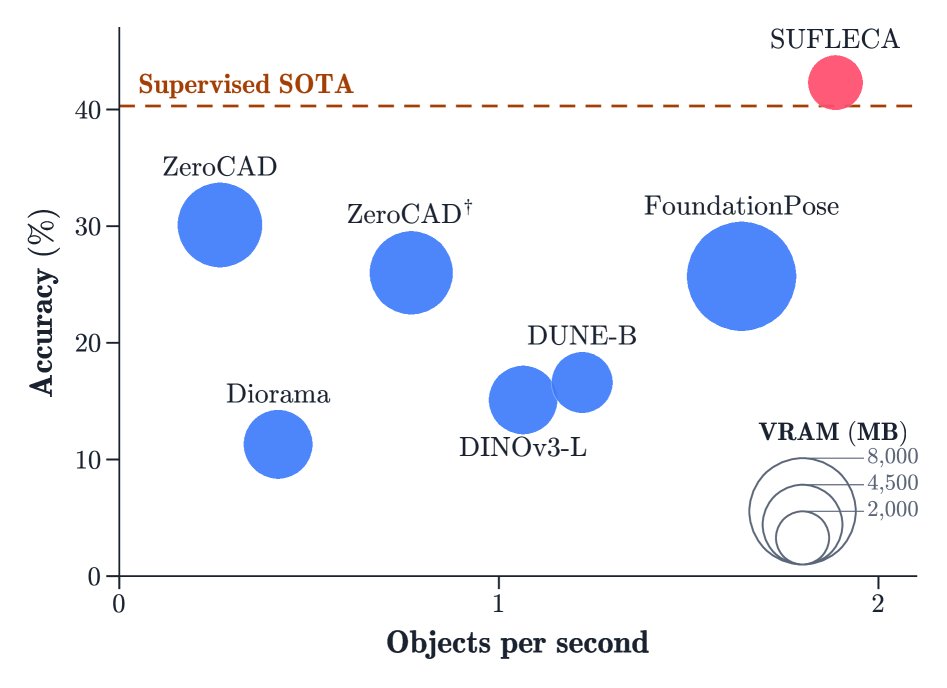
最接近的路线显然是 ZeroCAD:冻结视觉 backbone,用 NOC supervision 训练 adapter/feature,再做 CAD-to-image correspondence 和 pose estimation。SUFLECA 与它的本质差异不是“也用了 NOC”,而是把 NOC learning 从 synthetic isolated objects 扩展到多数据源真实/合成混合分布,并把 matching 从 semantic nearest-neighbor 改成带 mutuality 和 geometric consensus 的结构化估计。
与 ROCA/SPARC/MultiObj-SPARC 这类 supervised CAD alignment 相比,SUFLECA 不依赖 9D pose supervision,技术谱系更接近 weakly-supervised representation learning + classical geometric estimation。它不是端到端 pose regression,也不是 render-and-compare iterative optimization。
与 Diorama、DINO/DUNE feature matching 这类 foundation-feature zero-shot 方法相比,SUFLECA 的新增信息是 NOC grounding。通用 foundation features 提供 strong prior,但没有被专门校准到 canonical object coordinate;SUFLECA 的价值正是在这个中间层做 task-specific but weakly-supervised adaptation。
与 robust category-level pose/shape estimation 的关系在于 correspondence filtering 思想相似:都试图从 noisy measurements 中找最大一致集合。但 SUFLECA 把这个思想嵌入 CAD render-to-image dense matching,而不是依赖人工 keypoints、active shape models 或 category-specific shape priors。
看似新的部分中,大规模混合数据、NOC supervision、mutual matching、spectral/consensus filtering 都不是完全新概念;实质创新在于把它们针对 9D CAD alignment 的失败模式重新组合,并解决 anisotropic scale 下 correspondence consistency 的具体建模。
Dataset / Evaluation
评估覆盖了 ScanNet25k、DiffCAD split 和改造后的 CO3D,基本能验证 indoor CAD alignment 的核心 claim:在相同 upstream components 下,SUFLECA 的 correspondence 与 registration 更稳定。ScanNet25k 的结果尤其支持“无需 iterative refinement 也能超过现有 zero-shot baseline”这个结论。
但 evaluation 并没有完整验证 open-world CAD fitting。主 benchmark 仍是室内常见家具/物体,CAD retrieval 在主要设置中来自 ROCA 或 Scan2CAD-style pipeline;当换成 GroundedSAM + OSCAR 的 fully zero-shot retrieval,alignment accuracy 明显下降。这说明瓶颈被部分转移到了 retrieval 和 upstream perception。
CO3D 评估试图覆盖 unseen categories 和 inexact CAD,但协议包含 metric scale conversion、occluder simulation、SAM3D CAD pools、OSCAR retrieval 等多步适配。它能说明方法不是只在 ScanNet25k 上工作,但还不足以证明真正开放世界长尾泛化。
消融支持 correspondence filtering 和 fit score 的价值,但对 representation learning 的归因仍不够细。比如大规模数据、真实/合成 pairing、NOC annotation verification、backbone choice、feature dimensionality之间的贡献没有完全拆干净。因此“为什么提升这么多”仍有一部分可能主要来自 scaling / data。
Limitation
第一,方法严重依赖上游模块。mask 错、depth 偏、CAD retrieval 差,后面的 geometry-aware matching 只能有限补救。论文自己也显示 zero-shot retrieval accuracy 很低时 alignment 大幅下降;这意味着 SUFLECA 不是完整解决 CAD-to-image fitting,而是把 alignment 子问题做强。
第二,核心能力可能主要来自数据覆盖。674K 多数据源 NOC supervision 很关键,但这也意味着方法的上限受可获得 CAD/pose/depth/NOC annotation 的数据生态限制。长尾类别、户外物体、非标准 canonical orientation、可变形或 articulation 强的对象,未必能自然继承这个能力。
第三,NOC derivation pipeline 本身会引入 hidden supervision 和系统偏差。SAM2 mask、depth estimator、CAD overlay verification、monocular metric depth 都参与生成训练信号;文中未充分说明这些噪声如何影响 learned descriptor,也没有充分分析不同 annotation source 的偏差。
第四,泛化 claim 需要谨慎。排除 ScanNet-derived training 对 ScanNet25k 是必要的,但其他 indoor CAD datasets 与 ScanNet25k 在类别、几何形态、CAD annotation style 上可能仍高度相近。这里的泛化更像跨数据源 indoor object distribution 泛化,而不是强 open-set 泛化。
第五,geometric consensus 依赖有足够覆盖的正确 correspondence。严重遮挡、低纹理、强对称、只有单一平面可见、CAD 形状明显不匹配时,anisotropic scale 估计和 pairwise consistency 都可能退化。文中对这些 failure modes 的分析不够。
第六,效率优势部分来自不做 iterative refinement 和使用 compact descriptors,但 RANSAC 仍占主要 runtime。真实多实例、多 CAD candidate、多视角系统中,整体耗时可能由 upstream retrieval/render/cache 管理决定,论文的 per-instance alignment timing 不能直接代表 deployment cost。
Takeaway
- 1. 对 CAD-to-image alignment,最值得迁移的 insight 是:不要直接用 foundation features 做 correspondence;先用 geometry-grounded weak supervision 把 descriptor space 校准到任务所需的 latent coordinate structure。
- 2. 对跨模态真实图像到 CAD render 的问题,真实/合成 paired distribution 比纯 synthetic rendering 更重要。
- 这里的 scaling 不是盲目加数据,而是让训练分布覆盖 matching 两端的 domain gap 和 occlusion pattern。
- 3. Dense correspondence 任务中,feature similarity 应该只是 proposal 生成器,最终必须用任务几何约束做 set-level pruning。
一句话总结
SUFLECA 是 ZeroCAD 式 NOC-grounded zero-shot CAD alignment 的 scaling-and-geometry 版本:它真正推进的是用大规模弱监督把 foundation features 校准成可匹配的几何 descriptor,并用显式几何一致性替代单纯语义最近邻。