精读笔记
Problem Setting
论文真正解决的是 VLA finetuning 中 action supervision 与 pretrained multimodal representation 之间的冲突。VLA 通常复用 VLM backbone:同一条 multimodal pathway 既要服务语言侧 instruction generation / grounding,又要服务动作侧控制。问题在于,这两类需求对表征组织方式并不一致。语言侧希望保留丰富语义、上下文和对象关系;动作侧需要方向、局部几何、目标位置、可执行性等稳定控制变量。
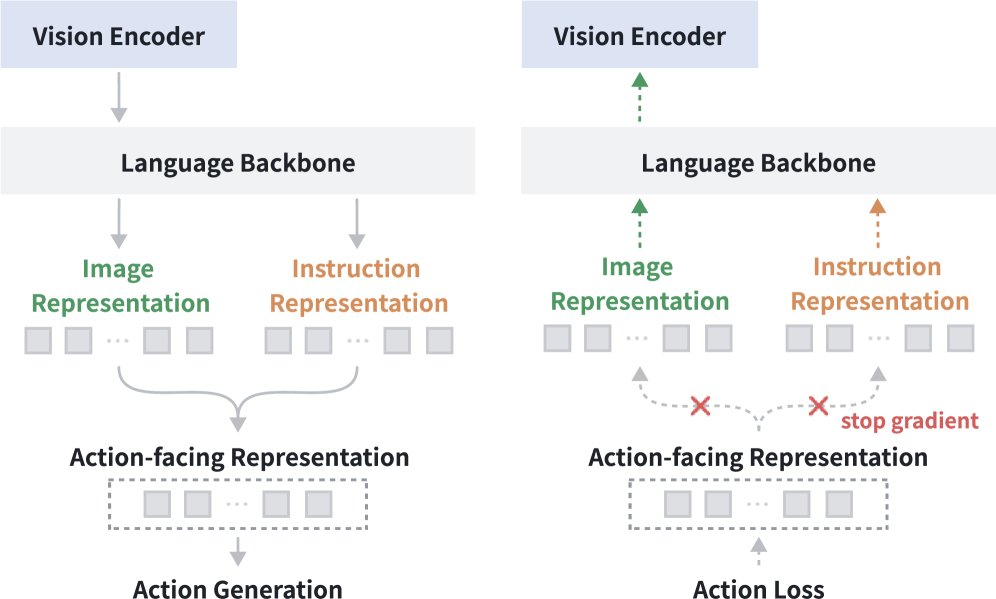
真正困难点不是视觉信息缺失,而是视觉-语言信息没有以 action-compatible 的方式暴露。direct fusion baseline 把 image-side 和 instruction-side hidden states 直接合并给 policy head,本质上假设 pretrained multimodal representation 只需一个 downstream decoder 就能读出动作。但论文显示 action loss 会反向改写这些 inherited representations:不改写,left/right 等动作区分不够清晰;改写太直接,又会破坏 instruction generation 和 visual grounding。
所以关键矛盾是:action supervision 必须进入表征空间,否则控制变量学不出来;但它不能以无约束方式重写共享 multimodal pathway,否则语言侧稳定性和对象 grounding 会崩。以前方法主要卡在把 action interface 看成 readout / tokenization / decoder,而不是看成 action loss 与 inherited representation 交互的结构性位置。
Motivation
已有 VLA 路线的隐含假设是:更强 VLM backbone 加更好的 action head 或 action tokenizer 就能提升 embodied control。这个假设漏掉了一个机制层问题:action loss 不是只训练 policy head,它会沿着 action interface 回传到 multimodal backbone,并改变 backbone 原先为语言和视觉 grounding 形成的结构。
作者的核心观察是 action-supervised shaping 有双重效应。一方面,它是必要的:left/right 这种语言上相近但动作上完全不同的 distinction,需要 action loss 把它显式拉开。另一方面,它是危险的:如果 action loss 直接作用于 inherited image/instruction hidden states,会诱发 broad upstream rewriting,表现为 token representation drift、attention center shift、instruction OOD 输出和 grounding instability。
因此缺口不是“缺一个更复杂 decoder”,而是缺一个能调节 action supervision 作用位置的中间层。这个中间层既要允许动作目标塑造表征,又要把这种塑造限制在更 action-facing、更可控的空间中。
Core Idea
Action QFormer 的核心思想是把 action interface 从被动 fusion/readout 改成主动的 representation-shaping mediator。它用一组 learnable queries 作为 action-facing latent slots,先吸收 instruction-side context,再通过 cross-attention 从 visual features 中选择动作相关证据。最终 policy head 看到的不是原始 inherited multimodal hidden states 的直接拼接,而是被 instruction-conditioned queries 重组后的 action-facing representation。
这个设计引入的 inductive bias 是:动作需要的视觉信息应当由当前指令约束地选择,而不是让 policy head 在混杂 multimodal token 上自行学习全局融合。更重要的是,它改变了梯度组织方式。action loss 可以先更新 query interface 和 query initialization,从而改变“如何读取/组织上游信息”,而不是只能通过大规模改写 backbone 表征来降低动作损失。
与 prior 的本质区别不在 QFormer 新颖性,而在使用位置和解释框架。BLIP-2 / InstructBLIP 的 query interface 主要用于视觉到语言的对齐和压缩;这里 query interface 被用作 action supervision 的缓冲层和重组织层。它不是单纯提高 multimodal alignment,而是控制 action loss 对 inherited representation 的重塑方式。
Method
方法中真正必要的机制只有几项。
第一,direct-fusion baseline 被当作诊断参照,而不是强 baseline 设计。它代表常见 VLA interface:抽取 image-side 和 instruction-side hidden states,self-attention fuse 后送入 policy head。这个 baseline 的作用是暴露 direct action shaping 的问题:它能让动作监督触达上游,但也容易造成广泛 representation rewriting。
第二,Action QFormer 用 instruction-conditioned queries 形成 action-facing representation。它解决的是信息选择问题:动作预测不需要完整 VLM 语义空间,而需要任务条件下的控制相关视觉证据。query bottleneck 迫使模型把视觉-语言信息压缩成少量 action-facing slots,这相当于对 action representation 施加结构约束。
第三,论文通过 stop-gradient settings 分析 action loss 的路线:blocking action update、blocking language backbone、freezing vision encoder、full update。这个设计的重要性在于,它把“性能提升”拆成了 representation shaping 的正负两面,而不是只报告 end-to-end navigation 成功率。
第四,语言生成和动作预测联合训练是必要实验条件,因为论文关心的正是共享 pathway 同时服务 instruction generation 与 action control 时的冲突。但具体 diffusion policy、8-step horizon、cosine loss schedule、query 数量等不是核心贡献,更像为了构造一个可测的 VLA navigation pipeline。
Key Insight / Why It Works
最重要的 insight 是:Action QFormer 的收益更像 better inductive bias + representation alignment,而不是 scaling、retrieval、test-time compute 或规划能力提升。它没有引入长期 memory、显式 planner,也没有证明更强 reasoning。它做的是把 action loss 的表达空间从 backbone hidden states 转移到 action-facing query slots,使动作监督优先学习“如何读取和组织 multimodal evidence”。
为什么有效:direct fusion 下,policy head 需要从大量 inherited tokens 中读出控制变量;如果读不出,梯度就会粗暴改写上游 token 表征。这种改写对动作有利,但会伤害语言侧结构。Action QFormer 提供了一个可训练的中间适配器,允许模型通过调整 query attention pattern 来获得方向、目标、局部几何等动作变量,从而减少对上游表示的全局破坏。
最可能的核心贡献是 gradient-routing 视角,而不是 Action QFormer 模块本身。QFormer-style query bottleneck 是已有思想,真正有价值的是作者把它解释为 action-supervised representation shaping 的控制界面,并用 left-right separation、token rewrite、attention drift 这些诊断指标把机制讲清楚。
哪些可能只是辅助:diffusion action head、GPT 生成 instruction、loss weight schedule、special token boundary parsing、query 数量和层数。这些会影响最终结果,但不构成机制上的新东西。部分增益也可能来自额外参数和正则化效应:query bottleneck 本身会减少过拟合和上游漂移,这未必只属于“structured shaping”。
需要直接指出的是,论文没有充分排除 capacity / optimization confound。Action QFormer 比 direct fusion 多了结构化计算和可训练 query slots,性能提升不一定全部来自更合理的 gradient routing。另一个问题是 evaluation 中的 instruction label 是 GPT 按未来轨迹生成的 constrained command,这可能让模型学到一种受限模板空间内的稳定映射;开放语言下的 instruction stability 未被充分验证。
Relation To Prior Work
这篇最接近三条线:VLA action interface、QFormer/Perceiver-style query bottleneck、robot navigation foundation models。
和 RT-2、OpenVLA、π0、FAST、VQ-VLA 等 action-interface 工作相比,它不主要改变 action representation 或 action decoder,而是研究 action loss 如何反过来塑造 inherited multimodal representation。也就是说,prior 关心“动作如何编码/生成”,本文关心“动作监督如何改写共享表征,以及如何控制这种改写”。
和 BLIP-2、InstructBLIP、Flamingo、Perceiver 的关系更直接。Action QFormer 在结构上并不新:learnable queries、cross-attention、latent bottleneck 都是成熟设计。实质创新在于把 query interface 放在 VLA 的 action-facing side,并把它解释为 gradient mediation mechanism,而不是单纯的 visual resampler。
和 VEGA、DynaFLIP、HARP-VLA、LARA、AGRA 这类 action-grounded / dynamics-aware representation alignment 工作相比,本文更强调 finetuning 阶段的梯度作用路径,而不是预训练阶段的对齐目标。它的新增信息是:action grounding 不只是让表示更接近动作语义,还要防止动作目标破坏原本用于语言和 grounding 的结构。
因此它属于“interface-mediated representation alignment”谱系:不是新 backbone,不是新 policy,不是新 planner,而是通过中间接口改变 multimodal representation 到 action representation 的组织方式和训练动力学。
Dataset / Evaluation
评估主要是 zero-shot sim-to-real ObjectNav-style navigation:模拟训练,真实室内场景部署,模型在闭环中先生成中间 instruction,再生成局部动作轨迹。这个设置确实能暴露 representation instability,因为 instruction OOD、方向错误、target drift 会在闭环中累积成失败。
但任务覆盖范围偏窄。它主要验证单帧、目标导航、局部轨迹生成中的方向控制和对象 grounding,并不能证明方法能处理长时规划、状态记忆、manipulation contact dynamics 或高维连续控制。closed-loop 场景数量也较有限,真实世界结果更像 targeted stress test,而不是大规模机器人泛化评估。
评价对核心 claim 有一定支持:fixed-instruction probes 控制了 instruction generation,使得增益不完全来自语言输出稳定;mechanistic analysis 又显示 direct fusion 的上游 rewriting 和 attention drift 更严重。这些证据支撑“Action QFormer 改变 action supervision shaping 方式”。
不过 evaluation 仍有明显 limitation。真实场景是否与训练 ObjectNav 分布存在语义/布局 overlap,文中未充分说明。instruction correctness、OOD instruction、trajectory correctness 有人工规则成分,可能引入 evaluation bias。更重要的是,benchmark 并没有证明模型获得了长期导航 reasoning;很多成功更可能来自局部视觉 grounding 与动作模板的稳定组合,而不是 planner 级能力。
Limitation
第一,方法成立依赖一个前提:pretrained multimodal backbone 已经包含足够视觉语义和 grounding 信息,只是没有以动作可读形式组织。如果 backbone 本身缺少目标、几何、可通行区域或机器人 embodiment 相关信息,Action QFormer 只能重新选择和压缩,不能凭空产生控制知识。
第二,scalability 上限不清楚。query interface 对局部导航有效,但高维 manipulation、接触动力学、双臂/ humanoid control 需要更细粒度时空状态和动作约束。固定数量 query slots 可能成为瓶颈;增加 query 和 depth 又可能退化成另一种大容量 fusion module。
第三,泛化证据有限。zero-shot sim-to-real 是强设置,但场景数量和任务类型有限。所谓 robustness 可能来自训练数据覆盖了足够 ObjectNav 局部模式,加上 constrained instruction templates 降低了语言分布复杂度。核心能力可能主要来自数据覆盖与模板化监督,Action QFormer 只是让读取更稳定。
第四,增益归因不清。Action QFormer 同时改变了 visual source、融合结构、参数量、梯度路径和 bottleneck 形态。文中机制分析很有价值,但还不能严格区分“structured gradient mediation”和“更强/更正则化的 adapter”之间的贡献。
第五,它可能只是把问题转移了:从 upstream backbone 被动作监督破坏,转移到 query interface 是否能承载足够 action-relevant abstraction。如果任务需要显式长期状态、地图、碰撞约束或因果规划,query interface 本身并不解决这些问题。
第六,reasoning / planning 成分很弱。模型预测的是 single-frame conditioned local trajectory,closed-loop 行为靠反复感知-生成-执行滚动出来。这里的“导航能力”更像局部 reactive grounding,而不是形成稳定的长期世界状态或计划。
Takeaway
- 1. VLA 的 action interface 不能只被看成 decoder。
- 它是 action loss 与 pretrained multimodal representation 发生冲突的关键位置,决定了 finetuning 是形成 action-compatible structure,还是破坏语言/视觉 grounding。
- 2. Query bottleneck 的价值不只是压缩视觉 token,而是给 action supervision 一个中间适配空间。
- 这个 insight 可以迁移到 manipulation、video VLA、world-model-conditioned policy:不要让下游控制 loss 无约束地直接重写共享 foundation backbone。
一句话总结
Action QFormer 是一篇把 VLA action interface 从“动作解码器”重新定义为“动作监督下表征重塑控制器”的论文,真正贡献在于揭示并缓解 action loss 对 pretrained multimodal representation 的双重作用。