精读笔记
Problem Setting
GraspGraphNet: Graph-Structured Multi-Embodiment Dexterous Grasp Generation(arXiv preprint / 2026)。
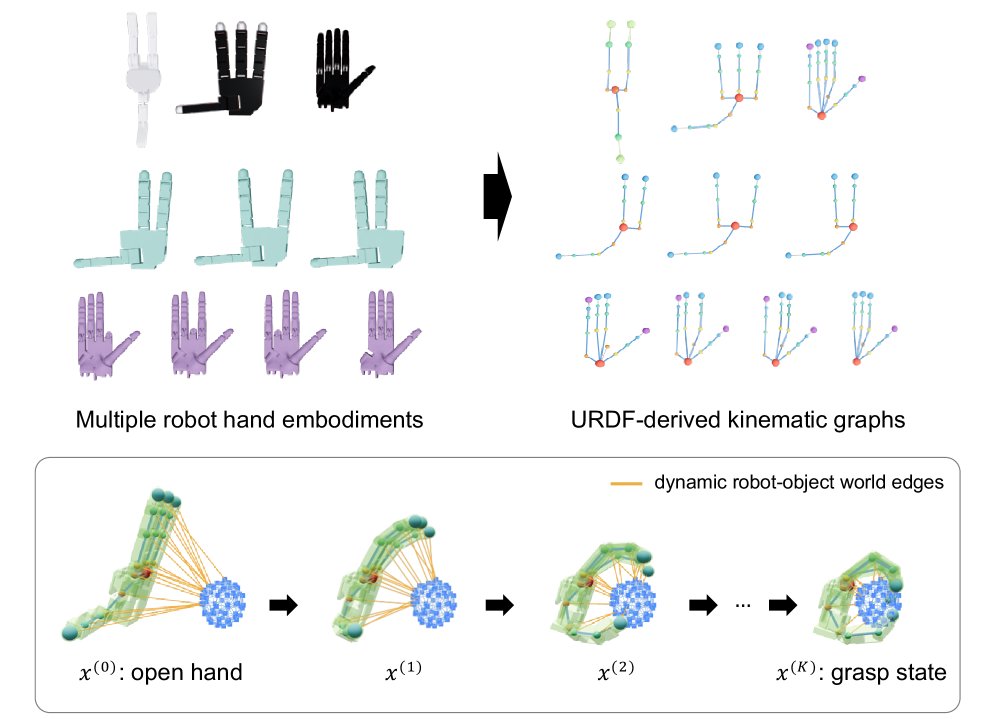
这篇论文解决的不是一般意义上的 dexterous grasp generation,而是 multi-embodiment setting 下的可执行抓取生成:同一个模型要接受不同灵巧手的 URDF、不同 link/joint 拓扑、不同 actuation dimension,并直接输出该手可执行的 palm pose 和 joint command。
真正困难点在于输出空间本身不共享。Barrett、Allegro、Shadow 这类手不仅自由度不同,kinematic tree、joint limits、finger layout、link geometry 也不同。传统 robot-centric 方法可以直接输出 command,但模型通常绑定一个 hand-specific vector space;contact-map / distance / transformation 这类 object-centric 或 interaction-centric 方法更容易迁移,但最终仍要通过 IK、optimization 或 retargeting 落回具体手的配置空间。
因此关键矛盾是 transferability vs. executability。已有方法为了跨手,往往牺牲直接可执行性;为了直接执行,又牺牲跨 embodiment 共享。本文试图把这个矛盾压到一个统一的 graph-conditioned executable-state generation 框架里。
Motivation
已有路线不够的地方在于,它们大多没有把“手的结构差异”作为模型的一等输入。contact map、keypoint、dense distance、robot-object transformation 等中间表征确实弱化了 joint-space 差异,但它们没有消除最后的 reconstruction problem。实际部署时,最脆弱的部分往往正是从中间表征到可执行关节命令的转换:IK 初始化、joint limit、collision/contact feasibility、手指缺失或拓扑变化都会影响结果。
作者的核心观察是:URDF 已经提供了跨机器人最自然的共享接口。不同手虽然没有共享 joint vector,但都可以被表示为 link-joint kinematic graph;每个 joint 的属性、父子关系、link geometry 和 FK 都是结构化的。也就是说,跨 embodiment 不是要强行找一个统一向量空间,而是要让模型在 variable-size graph 上共享局部计算规则。
关键缺口是:之前的 cross-embodiment grasping 往往把 transferability 建在 object/contact side,而没有把 executable command generation 直接建在 robot topology side。GraspGraphNet 填的是这个缺口。
Core Idea
本文真正的核心思想是:把每只灵巧手的可执行状态空间看作由 URDF graph 参数化的空间,而不是固定维度输出头。模型不预测 hand-agnostic grasp cue,再交给后处理;它直接在当前输入手的 palm pose + normalized joint state 空间中学习一个 conditional velocity field。
这个建模方式引入了两个重要 inductive bias。第一,robot-side 信息沿 kinematic tree 传播,因此参数共享发生在 link/joint 局部结构上,而不是发生在固定下标的 joint vector 上。第二,object-robot 信息流不是静态绑定的,而是通过 FK 后的当前 link pose 与 object surface points 动态建立邻接;也就是说,模型每一步都根据“手现在在哪里”重新决定应该看物体的哪部分。
和 prior 的本质区别在于,本文不是寻找更好的 transferable intermediate representation,而是把 transferable representation 与 executable output 合并到同一个 graph-conditioned generator 中。它改变了跨手抓取生成的信息组织方式:从“先预测跨手 cue,再还原到具体手”变成“用具体手的结构作为条件,直接生成具体手的命令”。
Method
方法层面需要保留的关键机制有四个。
第一,URDF-derived robot graph 解决的是 embodiment variability。link 是 node,joint 是 directed edge,edge 带 joint axis、limit、type 和 fixed transform,link geometry 作为 node feature。这样模型可以处理不同 graph size、connectivity 和 joint dimension;输出 joint velocity 时也不依赖固定长度的 hand-specific head。
第二,differentiable FK 解决的是 joint-space 与 contact geometry 脱节的问题。当前 grasp state 先经过 FK 得到每个 link 的 world pose,再用这些 pose 构造 robot node feature。核心变化是:网络看到的不是抽象 joint vector,而是当前 articulated hand 在物体坐标系中的几何状态。
第三,dynamic world-edge message passing 解决的是接触邻域随生成过程变化的问题。抓取不是一次静态匹配;手从 open pose 移向物体时,每个 link 相关的 surface patch 会不断变。每一步重建 link-object kNN edge,本质上是在做 state-dependent local interaction retrieval,并把局部几何信息注入 robot nodes。
第四,conditional flow matching 解决的是多模态抓取不适合 direct regression 的问题。它从 open-hand initialization 出发,学习把状态推向某个可行 grasp 的 velocity field。这里的价值不是理论上多复杂,而是它提供了低步数、状态依赖、可直接作用于 executable state 的 refinement 机制,避免 diffusion 的高采样成本和中间表征的 reconstruction 成本。
Key Insight / Why It Works
最可能真正起作用的是 representation alignment,而不是某个单独网络模块。URDF graph 让模型的输入结构与机器人运动学一致;FK 让 joint state 与世界几何一致;dynamic world edges 让 object feature 与当前潜在接触区域一致;flow matching 让生成过程与从 open hand 到 grasp 的轨迹一致。这几个 alignment 叠在一起,使模型不需要在一个固定 latent vector 里隐式学完整的 embodiment mapping。
Dynamic world edges 可能是最核心贡献。消融显示 static edge 掉得很厉害,这符合直觉:抓取生成过程中,初始 open-hand pose 附近的 object neighbors 与最终接触区域可能完全不同。固定 interaction graph 实际上会把错误的 surface evidence 注入后续状态。动态重连相当于每一步基于当前 FK 做 local geometric retrieval,这比纯 graph message passing 更接近真实 contact formation。
Flow matching 的作用需要谨慎看。它显著优于 direct regression,但这并不必然说明模型学到了复杂的连续抓取动力学;也可能只是多步 state-conditioned correction 避免了多解平均。K 从 3 增加到 20 收益很小,说明 test-time compute 不是主要来源,核心大概在前三步的粗到细 refinement。它更像高效 conditional transport,而不是完整 grasp planning。
URDF graph 的 topology generalization 也要有限解释。finger removal 结果说明模型能处理 graph size / joint dimension 的局部变化,但这不等价于 zero-shot morphology generalization。删除已见手的一根手指,仍然保留了大量训练分布中的 link geometry、finger kinematics 和 grasp style。真正跨到全新机构、不同掌面布局、欠驱动结构或非人形手,文中未充分说明。
因此本文的有效性更像是 better inductive bias + state-dependent retrieval + executable representation alignment 的组合,而不是单纯 scaling。数据覆盖仍然很重要;如果训练集没有覆盖相近的 object geometry、hand morphology 和 grasp modes,graph 结构本身不会凭空产生抓取策略。
Relation To Prior Work
最接近的技术谱系是 cross-embodiment dexterous grasping 中的 contact-centric / interaction-centric 表征路线,包括 GenDexGrasp、DRO-Grasp、TRO-Grasp。本文沿用了一个重要共识:跨手迁移不能只看 object geometry,必须显式建模 robot-object interaction。但它把 interaction representation 从中间目标推进到 executable state generator 的内部条件。
和 GenDexGrasp / contact-map 类方法相比,本文的本质差异是避免把 feasibility 留给后处理。contact map 是 transferable,但不是 command;GraspGraphNet 的输出本身就是 palm pose 和 joint configuration。
和 DRO-Grasp 相比,本文不是只建模 dense robot-object distance relationship,而是把 robot 的 kinematic topology 与当前 FK state 纳入生成过程。DRO 的强项是 interaction representation 的可迁移性,但仍需要 reconstruction;GraspGraphNet 的强项是 interaction 与 command space 对齐。
和 TRO-Grasp 相比,两者都用 graph/diffusion-ish generative modeling 和 robot-object spatial relation,但 TRO 仍偏 intermediate transformation graph,再经 IK 还原。GraspGraphNet 的实质创新是把 graph structure 放在 robot embodiment side,并用 shared per-joint velocity head 直接组装 variable-dimensional executable output。
看似新的部分里,PointNet++ object hierarchy、MPNN、cross-attention、6D rotation、flow matching 都不是新概念;真正有价值的是这些东西被组织成一个 topology-conditioned executable grasp generator。创新主要在系统性重组与归纳偏置,而不是单点算法发明。
Dataset / Evaluation
评估覆盖 Barrett、Allegro、Shadow 三种手,并额外加入 finger-removal variants,这确实比只在单手或少量 held-out objects 上报告更能支持 multi-embodiment claim。40 个 unseen objects 的 simulation benchmark 也比若干 prior setting 更宽一些,但仍然是相对受控的 object-level generalization。
finger-removal 实验是本文最有信息量的部分,因为它直接改变 graph topology、link set 和 actuated joint dimension,并且不重新训练。结果支持“URDF graph input 可以吸收局部拓扑变化”这个 claim。但它验证的是 controlled topology modification,不是无约束的新 embodiment generalization。删除手指与换一只结构完全不同的新手之间有很大差距。
真实世界实验使用 Leap Hand 和 RGB-D partial point cloud,并进行了 fine-tuning。它说明 pipeline 可以落到物理系统上,但不能强证明 zero-shot real-world transfer;因为对象数量少、试次数有限,而且用了 Leap data fine-tuning。这里更像 deployment feasibility demonstration,而不是严肃的 sim-to-real generalization benchmark。
baseline 对比总体合理,但也存在归因混杂:本文直接输出 executable command,而一些 baseline 需要 optimization / IK / reconstruction,因此 inference time 优势部分来自 problem formulation。成功率优势也可能受后处理质量、baseline adaptation 程度、训练实现细节影响。文中未充分说明这些实现差异是否完全公平。
Limitation
第一,泛化上限不清楚。论文强调 topology variation,但主要证据来自已见手的 finger-removal variants。这种变化保留了原手的大部分 morphology 和 kinematic motifs。对 substantially different morphology 的 zero-shot 泛化,作者在 conclusion 中也承认是 future work。
第二,方法强依赖 URDF 与几何模型质量。URDF graph、joint limits、link mesh sampling、palm frame canonicalization、palm-to-wrist offset 都是前提。如果 URDF 不准、link collision geometry 与真实手不一致、关节存在 backlash 或欠驱动耦合,模型输出的 executable state 未必物理可行。
第三,dynamic world-edge 更像 state-dependent geometric retrieval,而不是显式 contact reasoning。它通过 nearest object points 提供局部 surface evidence,但没有真正建模摩擦锥、接触力闭合、接触时序或闭环控制。抓取稳定性主要由数据和 simulator supervision 间接塑造。
第四,flow matching 没有解决长期规划。生成过程从 open hand 到 grasp,K 很小,缺少对中间碰撞、接触建立顺序、物体移动、环境约束的显式建模。所谓 trajectory integration 更像 few-step refinement,而不是 manipulation planning。
第五,增益来源不完全可分。动态 edge、cross-attention、flow matching、direct executable output、baseline 后处理开销、数据覆盖都在贡献性能。虽然消融支持若干模块必要性,但仍难判断 graph topology 本身贡献了多少,尤其是在原始三手 benchmark 上。
第六,partial observation 与真实部署仍是薄弱点。真实实验规模较小且经过 Leap fine-tuning,无法说明模型面对严重遮挡、透明/反光物体、桌面约束、动态干扰或控制误差时是否稳定。
Takeaway
- 1. 跨 embodiment dexterous grasping 的核心接口可能不应该是 contact map,而应该是 robot structure 本身:URDF graph 提供了比固定 joint vector 更自然的共享计算单位。
- 2. 对需要接触的生成任务,state-conditioned interaction graph 很关键。
- 静态 object-robot feature fusion 很容易在生成过程中失效;随着 action/state 更新重建局部邻域,是一个可迁移到 manipulation、locomotion-contact、tool-use 的 insight。
- 3. Direct executable generation 是重要方向。
一句话总结
GraspGraphNet 是 cross-embodiment dexterous grasping 从 hand-agnostic intermediate representation 向 URDF-conditioned executable-state generation 演化的一步,真正贡献在于用运动学图、FK 对齐和动态几何邻接把跨手共享计算直接接到可执行命令空间。