精读笔记
Problem Setting
论文标题:Diffusion-Residual Model Predictive Steering Control for Vehicle Stabilization at the Limit of Handling under Model Uncertainty(arXiv preprint / 2026-07-14)。
这篇论文真正处理的是极限操稳下 MPC 的“目标与约束校准”问题,而不是重新发明一个控制器。给定一个传统 active front steering LTV-MPC,闭环表现高度依赖两件事:yaw-rate reference 是否代表当前轮胎/路面/车辆真正可达到的 yaw,以及 stable-handling envelope 的 margin 是否和当前模型误差匹配。
困难点在于,这两个量都不是静态参数。接近 friction limit 时,线性 bicycle model 的 yaw prediction 会突然失真;同一 steering command 在不同轮胎、载荷、车辆、路面下对应的可达 yaw 和 sideslip 风险都不同。以前的固定 reference 容易在低附着下 over-command,robust/tube MPC 则倾向于用 worst-case margin 缩小可行域,恰好牺牲极限操稳需要的可用 envelope。关键矛盾是:控制器需要提前保守,但不能全局保守;需要学习误差,但不能把一个不可信 learned model 直接塞进 safety-critical control loop。
Motivation
作者的核心观察很清楚:极限操稳中,很多失败不是因为反馈不够强,而是 MPC 追踪了一个物理上不可实现的 yaw reference,或使用了一个由 nominal model 定义、但在极限区域已经失真的稳定包络。也就是说,问题发生在 predictive layer,而不是低层控制律。
已有路线缺的是 operating-point-conditioned residual uncertainty,并且这个 uncertainty 要以控制器能使用的形式进入 reference 和 constraints。GP-MPC / cautious MPC 有 chance-constraint 形式,但通常受限于高斯后验和相对平滑的残差假设;friction-adaptive NMPC 显式估计摩擦,但把不确定性压缩成单个 friction parameter;learned residual control 可以修正 dynamics,却往往没有把 second moment 转化成可审计的 envelope margin。
所以本文选择 diffusion 的动机不是在线生成轨迹,而是用它学习非高斯、异方差、饱和形状明显的 residual distribution,再把这个 distribution 降维成 MPC 可用的两个 moment。真正缺口是:如何把 learned uncertainty 变成稳定化 MPC 的 reference governor 和 constraint back-off,而不是一个黑箱动力学替代品。
Core Idea
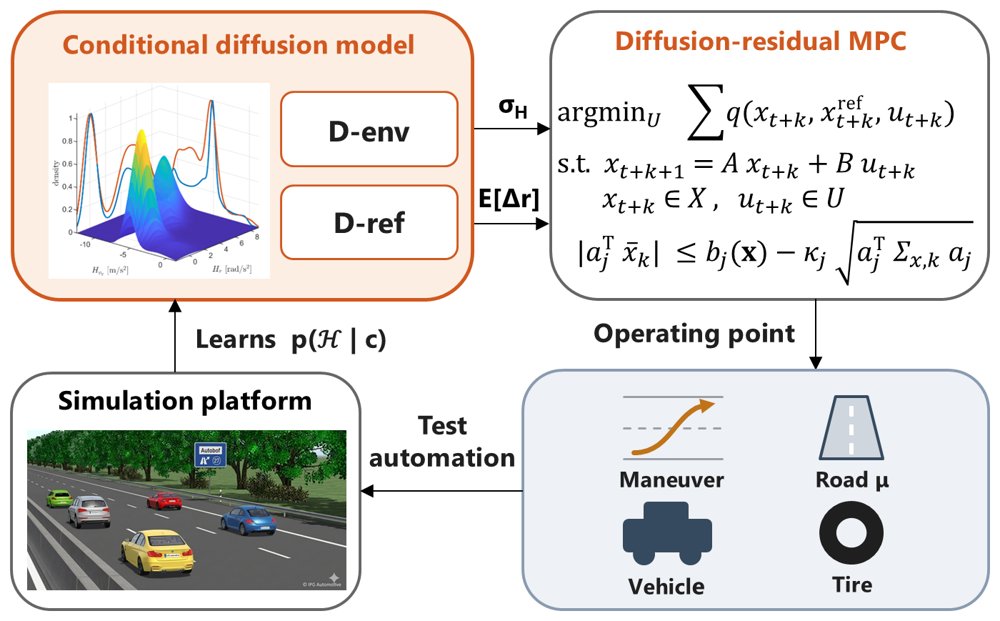
核心思想可以概括为:学习 nominal bicycle model 在当前 command 下会错到哪里,但不让 learned model 接管控制。diffusion residual generator conditioned on speed and steering command,输出 residual 的 mean 和 spread;mean 用来把线性 yaw reference 拉回 achievable yaw,spread 用来提前收紧 stable-handling envelope。这样 learning 改变的是 MPC 的“问题表述”,不是 MPC 的“求解器”或“控制律”。
这引入了一个很有用的 inductive bias:车辆动力学主干仍由可解释的 nominal MPC 负责,学习模块只负责 operating-point-dependent calibration。对于 safety-critical 控制,这比 diffusion planner 或 learned dynamics MPC 更稳妥,因为在线优化仍是小规模 QP,约束结构保持不变,生成模型也不在控制频率内采样。
和 prior 的本质区别在于 second moment 的落点。很多 learned residual 方法把均值当 feedforward correction;本文把不确定性直接投影到 Beal-Gerdes handling envelope 的 chance back-off 上。这个信息流使“哪里不确定,哪里提前收缩可行域”成为控制机制的一部分,而不是事后靠高增益反馈消化误差。
Method
方法层面最重要的不是 DDPM 细节,而是三个机制。
第一,reference residual learning。线性 understeer relation 在 tire saturation 和低附着下系统性高估 achievable yaw,因此 D-ref 学习 Δr_ref = r - r_lin 的条件均值,并把 yaw reference 改成 r_lin + E[Δr_ref | command]。它解决的是目标错误,不是跟踪误差。实验也表明这是主要收益来源。
第二,envelope residual spread propagation。D-env 学习 state-derivative residual 的 spread,并通过线性预测模型传播到 horizon 上的 state covariance,再沿 handling-envelope facet normal 做 one-sided chance back-off。它解决的是安全边界误差随 operating point 变化的问题。这里的关键变化是 margin 从固定人工调参变成 data-conditioned margin。
第三,offline moment tabulation。diffusion 只在离线阶段用于估计条件分布的 mean/std,在线控制只做表查找和解析 back-off。这使方法更像 learned calibration table + stochastic MPC,而不是 in-loop generative control。这个设计牺牲了一部分在线适应性,但换来了实时性和工程可部署性。
Key Insight / Why It Works
最核心的有效性来源大概率是 reference re-sizing,而不是 diffusion 本身,也不是 chance constraint 本身。低附着 step 中 nominal MPC 发散,是因为它追踪了 μ=1 假设下的过大 yaw demand;只要 learned mean 能把 target 拉回可达 yaw,闭环就会从 spin 回到稳定区域。论文自己的 ablation 也基本承认:D-ref 单独已经消掉大部分灾难性 failure,D-env 更多是在尾部和干地 transient limit 上加 margin。
diffusion 的真实价值在于它更适合拟合 near-limit residual 的非高斯饱和形状。轮胎饱和导致 residual 不是对称噪声,而是向“更少 yaw than linear model promises”偏斜,并在 grip limit 附近堆积。GP 的平滑高斯后验会把这种 sharply saturated map 过度平滑,尤其在 CarMaker 高保真 tier 上差距被放大。因此 diffusion 的优势更像 better conditional density / better inductive bias,而不是 test-time reasoning。
chance back-off 的贡献更微妙。它不是主要 rescue mechanism,而是把 learned spread 转成 self-gating caution:只有接近 active yaw/rear-slip bound 时才真正收缩约束。这个机制值得迁移,因为它避免了 fixed robust margin 的全局保守。但文中的 Gaussian moment back-off 在非高斯残差下并不严格,作者也承认 per-step coverage 不足;闭环风险看起来合格,很大程度是因为均值 correction 已经把系统带离危险区。
从技术归因看,这篇更接近 data-conditioned residual lookup / learned reference governor,而不是 generative planning。所谓 diffusion-residual 的 planning 能力不要高估:在线没有 diffusion sampling,没有长期 latent dynamics 推理,moment table 也固定。核心能力可能主要来自训练数据覆盖了 vehicle × tire × road × maneuver 的 residual surface,并且 evaluation 与这个 surface 同域。
Relation To Prior Work
它属于 learning-based MPC / cautious MPC / reference governor 的交叉谱系,而不是 diffusion planning 的主线。和 diffusion planner、diffusion predictive control 的区别是:本文不生成动作序列、不生成轨迹、不把 diffusion world model 放进 MPC rollout;diffusion 只提供 residual moments。这个边界很重要,也让方法更工程化。
和 GP-MPC / cautious MPC 的关系更近。Gaussian-moment tightening、covariance propagation、chance back-off 都是已有 stochastic MPC 思想;新增的是 residual uncertainty 的来源和使用位置:用 command-conditioned diffusion generator 同时服务 reference re-sizing 与 envelope back-off。也就是说,数学框架不新,新的部分是把非高斯 residual generator 接到稳定化 MPC 最敏感的两个入口。
和 friction-adaptive NMPC 相比,本文不显式估 μ,也不把 uncertainty 限制为 tire-road friction parameter,而是直接学习 operating-point residual。这更 flexible,但也更 data-driven,物理可解释性和外推能力更弱。和 residual dynamics learning 相比,它没有把均值残差加进 dynamics,而是把均值用于 reference;这是一个正确且克制的设计,因为 dynamics residual feedforward 在 safety-critical 场景里容易和反馈补偿纠缠,增益归因也更乱。
实质创新在于:把 diffusion 的 predictive spread 用作 stable-handling envelope 的 one-sided chance back-off,并把 diffusion mean 用作 achievable-yaw reference governor。看似新颖的 diffusion 组件本身不是贡献主体,贡献主体是接口设计。
Dataset / Evaluation
评估覆盖面在该方向里算强:四类车辆、两类轮胎/载荷扰动、干地和低附着、多种 ISO/FMVSS maneuver,并且有 7-DOF 与 CarMaker 两个仿真层级。这个设置确实支持“在同域仿真范围内,固定 bicycle MPC 的误差会随 operating point 放大,而 learned residual calibration 能改善稳定性”的 claim。
更关键的是 ablation 设计相对干净:NOM、D-env、D-ref、GP-ref、D-res 构成了 mean vs spread、diffusion vs Gaussian 的拆解。结果说明 reference mean 是主因,spread 是辅助 tail margin,diffusion 相对 GP 的优势主要在高保真 CarMaker 的 near-limit 饱和区。这种归因比单纯报 D-res 最好更有价值。
但 evaluation 仍有明显边界。第一,generator 是 per tier retrained,说明跨 simulator / 跨 fidelity 泛化没有真正证明。第二,CarMaker 是高保真仿真,不是真车;on-target timing 只是执行时间验证,不是 HIL 或 vehicle test。第三,训练与测试都在同一个 maneuver family 和车辆/路面设计空间内,泛化更像 interpolation。第四,低附着恢复在 μ 未显式输入的情况下成立,可能依赖训练集中低附着 residual 被 command-conditioned mean 记住;这对未见摩擦、混合附着、瞬态 μ 变化未必可靠。
Limitation
最大限制是方法把困难从在线控制转移到了离线 residual coverage。只要 command-conditioned table 覆盖当前 operating point,它就很好用;一旦遇到未覆盖的 tire compound、载荷转移、路面突变、坡度、制动耦合或 actuator interaction,表面插值可能给出自信但错误的 reference 和 margin。
command-only conditioning 是一个强假设。相同 speed/steering 下,车辆状态、路面 μ、纵向加速度、温度、载荷转移都可能改变 achievable yaw。作者故意不输入 μ,以避免摩擦估计错误导致约束跳变;这是工程上可以理解的 trade-off,但代价是 uncertainty 被边缘化到训练分布上。低附着 under-coverage 的问题文中其实已经暴露,只是均值 re-sizing 在测试集上足够强。
安全性也没有理论闭环保证。soft slack 保证 QP 不 infeasible,但不保证 recursive feasibility 或 closed-loop stability。Gaussian chance constraint 在非高斯 residual 下只是 surrogate,且 per-step nominal coverage 并不可靠。文中用 closed-loop audited aggregate risk 来补这个洞,但这不是 safety certification。
diffusion 的必要性也没有完全钉死。GP baseline 有说服力,但还不够排除更直接的 conditional quantile regression、mixture density network、normalizing flow、ensemble 或分段物理模型。考虑到在线只用 mean/std,diffusion 可能主要是一个离线 density estimator;如果最终部署的是 37 kB moment table,那么核心能力可能来自 data scaling 与表面拟合,而不是 diffusion-specific generation。
最后,steering-only 范围限制很硬。低附着 brake-in-turn、强制动入弯、combined longitudinal-lateral demand 本质上需要 ESC/制动/驱动协调;仅靠 AFS 的 reference correction 无法改变摩擦预算。论文也承认 M6-low 是 maneuver-design limit,这说明控制 authority 已经成为上限。
Takeaway
- 1. 对 safety-critical MPC,学习模块最有价值的位置未必是 dynamics 或 policy,而可能是 reference 与 constraint margin。
- 这篇论文把这个判断做得比较清楚。
- 2. 极限操稳里的大收益来自“不要追踪错误目标”。
- 在低附着和饱和区,reference governor 式的 learned achievable-yaw correction 比更强反馈或更复杂优化更关键。
一句话总结
这篇论文把 diffusion 从在线生成式控制降级但也用对了位置:作为离线 residual distribution estimator,为传统稳定化 MPC 提供 achievable-reference re-sizing 和 data-conditioned chance margin,是 learned calibration + cautious MPC 方向的一次有效重组。