精读笔记
Problem Setting
论文标题:AnyDexRT: Calibration-Free Dexterous Hand Retargeting with Few-Shot Human Guidance(arXiv preprint / 2026)。
这篇论文解决的是 dexterous teleoperation 中最容易被低估但实际最决定体验的部分:human fingertip motion 到 robot hand command 的 retargeting。难点不在于给定目标点求 IK,而在于 human hand 与 robot hand 的 fingertip motion spaces 不是同构空间:尺度、joint limit、coupling、冗余可达区域、传感器 frame 偏差都会让“直接匹配姿态”变成错误目标。
以前方法卡在两个方向:optimization-based retargeting 需要大量 hand-specific task vectors、scale factors、offsets 和 weights;learning-based 方法如果只是模仿这些目标,仍然继承 calibration 依赖。GeoRT 这类几何空间对齐减少了人工对应设计,但它默认 human/robot fingertip spaces 可以全局双向匹配。这个假设在 dexterous hand 上很危险,因为机器人手常有许多人手自然动作不会使用的可达区域。关键矛盾是:想要无监督/自监督的可扩展 correspondence,但又不能让全局几何匹配把任务相关的自然映射拉歪。
Motivation
作者真正的 motivation 是反对“retargeting = pose/space full matching”这个建模习惯。teleoperation 需要的是操作者觉得可预测、可控、符合意图的 robot response,而不是覆盖整个 robot reachable space。对灵巧手来说,robot-only regions 往往是冗余自由度带来的产物,不是人类动作意图的自然对应。
因此缺的不是更复杂的 neural network,而是一个更合适的 inductive bias:只要求 human natural motion manifold 被嵌入到 robot feasible manifold 中,不要求反向覆盖;同时用少量人类指导去消除无监督匹配的多解性。这个方向的合理性在于,teleoperation 的目标本来就是 preserving intent under embodiment mismatch,而不是 reconstructing human hand geometry。
Core Idea
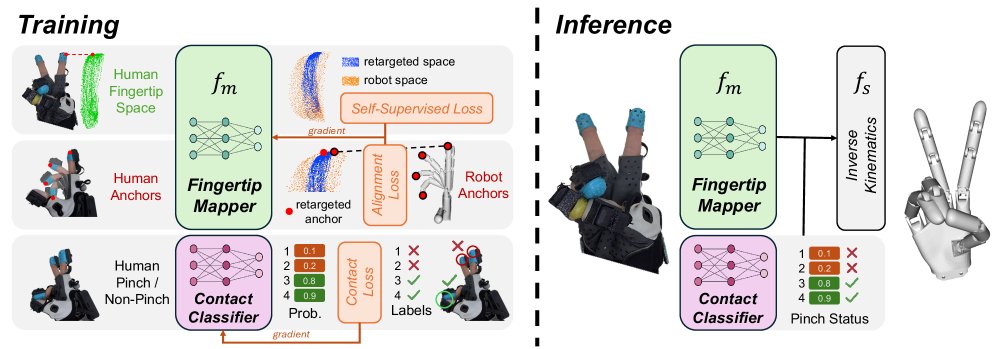
AnyDexRT 的核心思想是把 retargeting 建模成 human fingertip manifold 到 robot fingertip feasible subspace 的 partial correspondence,而不是 human/robot spaces 的全局双向配准。这个改动很关键:它承认 robot hand 的额外可达区域不一定应该参与匹配,从目标函数上避免“为了覆盖机器人空间而牺牲人类动作结构”。
然后,论文用 few-shot human guidance 给这个 partial correspondence 加锚点。自监督形状匹配提供 scale/generalization,anchors 提供任务相关区域和操作者偏好的 disambiguation。换句话说,AnyDexRT 的信息流是:大量 unpaired geometry 决定可行空间,少量 paired human guidance 决定语义方向和自然性,contact classifier 处理 fingertip geometry 不可靠的高精度接触特例。相比 prior,它不是把 calibration 做得更准,而是把 calibration 从连续手工调参转成稀疏语义锚定。
Method
关键机制可以压缩成四个必要约束。
第一,partial Chamfer 解决 robot reachable space 冗余导致的错误全局匹配。它只惩罚 mapped human fingertip 是否落到 robot feasible samples 附近,不要求 robot samples 全部被覆盖。核心变化是从 bidirectional coverage 改成 one-way feasible embedding。
第二,distance preservation 解决 partial matching 下的几何塌缩和分布扭曲。如果只要求 mapped points 靠近 robot feasible set,网络可以学到局部不自然的折叠映射;pairwise distance 约束把 human manifold 的内部结构保留下来。
第三,local motion preservation 解决操作者控制方向的一致性。teleoperation 中用户关心的是“我手指往这个局部方向动,机器人是否也按类似方向响应”。使用局部 frame 比全局 frame 更抗 glove calibration 和坐标 misalignment。
第四,few-shot anchors 解决 correspondence 的多解性。无监督几何匹配可以产生多个几何合理但语义不等价的映射;anchors 把解固定到操作者可接受的 bending / lateral rotation 区域。Pinch classifier 是额外的 contact-intent override:当传感器位置无法准确反映接触时,不再相信连续几何映射,而是分类 contact pattern 后检索机器人 pinch template。
Key Insight / Why It Works
最核心的有效性来自 better inductive bias,而不是网络规模。把 full correspondence 改成 partial correspondence 是这篇最实质的技术判断:robot hand 的冗余可达空间不是需要覆盖的 target distribution,而是需要避开的 nuisance space。这个判断直接解释了为什么 GeoRT 在某些手上会产生几何合理但 teleoperation 不直觉的结果。
第二个关键点是 anchors 的信息密度很高。少量 paired gestures 不是普通监督样本,而是在 correspondence 多解空间里提供 gauge fixing:确定尺度、偏移、弯曲方向、侧向旋转偏好和操作者习惯。它们解决的是 identifiability,不是简单提升拟合精度。因此 few-shot guidance 的作用可能比论文表述中更核心。
第三,local motion consistency 比 global motion consistency 更贴近 teleoperation。真实 glove/hand frame 很难完美校准,global direction metric 可能奖励错误目标。AnyDexRT 把一致性定义在局部坐标中,本质是在优化用户感知到的 differential control law。
Pinch refinement 更像 engineering + retrieval,而不是 retargeting 理论的一部分。它承认 sensor geometry 在接触附近失败,然后用 contact classifier 加 template search 修正。这很实用,但增益来源不清:Pick-10 的提升可能主要来自 contact-aware retrieval,而不是主 mapper 的泛化。NNS 解 joint configuration 也带有 memory reuse / retrieval 色彩,整体系统并非纯 continuous mapping。
如果要判断贡献排序:partial correspondence + anchors 是核心;local motion loss 是重要辅助;contact classifier 是针对 pinch failure mode 的有效工程补丁;MLP architecture 和训练 recipe 基本不是贡献。
Relation To Prior Work
它最接近 GeoRT:都把 retargeting 看作 human/robot fingertip reachable spaces 的几何 correspondence,并用 neural mapper amortize runtime。但本质差异在于 GeoRT 倾向全局双向空间对齐,而 AnyDexRT 明确采用 one-way partial alignment,并加入 human anchors 解决 ambiguity。这个差异不是小 loss 改动,而是对 retargeting 目标的重新定义。
和传统 optimization-based 方法相比,AnyDexRT 不再手工设计 task vectors、scale factors 和 objective weights,而是从 samples 中学习 fingertip manifold correspondence。它仍然没有摆脱几何 retargeting 谱系:不是 policy learning,不做 task planning,也不理解物体状态;它属于 calibration-light geometric retargeting / correspondence learning 的延伸。
看似新的部分里,partial Chamfer、distance preservation、local consistency、few-shot anchors 都不是孤立新概念,更多是已有 shape matching / manifold regularization / sparse supervision 思想在 dexterous retargeting 中的正确重组。实质创新在于作者识别出 full robot-space coverage 是错误 inductive bias,并把 few-shot human guidance 用作 correspondence disambiguation,而不是用来训练一个大监督模型。
Dataset / Evaluation
仿真实验覆盖 7 种 human-like dexterous hands,DoF 和结构有一定差异,能较好支撑“跨手型 retargeting quality”和“训练稳定性”的 claim。指标选择上,作者主动弱化 whole-space coverage,强调 local motion consistency,这与论文立场一致:teleoperation 不是追求覆盖机器人所有可达区域。
真实世界实验有价值,因为它不是只停留在离线几何指标,而是在 Wuji Hand + Manus glove + robot arm 上评估了 spray、screw、shovel、pick 等任务。任务覆盖了 finger-specific actuation、power grasp、tool use 和 pinch,能够验证直觉性和实用性的一部分。
但 evaluation 的上限也很明显。真实世界只验证了一个 robot hand,跨 hand generality 主要来自仿真;任务数量和物体类别有限;用户研究规模不大。更重要的是,论文声称 retargeting 有利于 imitation learning data collection,但没有训练 downstream policy 来验证数据质量是否真的更好。因此实验支持“teleoperation 更顺手”强于支持“收集的数据更适合学习”。
Limitation
第一,方法强依赖 human-like morphology。A1/A2 实际很重:如果机器人手不是类人结构,或者 human fingertip manifold 不能自然嵌入 robot feasible space,partial correspondence 也会失去语义基础。
第二,所谓 calibration-free 有边界。它减少的是精确 frame calibration 和手工 objective tuning,但仍需要 anchors、normalization、robot reachable samples、pinch templates,以及从 fingertip 到 joint 的 NNS/IK 后端。问题并没有消失,只是从显式 calibration 转移到数据覆盖和 anchor design。
第三,泛化可能主要是 morphology family 内泛化,而不是开放形态泛化。7 手仿真说明它能适配多种类人手,但不说明能适配非类人、欠驱动、软体、强耦合或缺少独立 fingertips 的手。
第四,增益归因仍不完全清晰。ablation 显示 anchors 有贡献,但没有充分拆解 anchor 数量、anchor 类型、operator-specific preference、robot sample density、NNS retrieval quality 对结果的影响。尤其 real-world pinch 的提升可能主要来自 contact classifier/template retrieval,而不是主 mapping objective。
第五,contact-rich manipulation 被简化成 pinch detection。更复杂的掌面接触、滑动、rolling、multi-finger force closure、in-hand reorientation 都没有被 contact model 真正覆盖。planner 或长期状态建模不存在;系统仍是 instant retargeting,不具备任务级 reasoning。
Takeaway
- 1. dexterous retargeting 里,“覆盖 robot reachable space”不一定是优点;对 teleoperation 来说,更合理的目标是把 human natural motion manifold 稳定嵌入 robot feasible submanifold。
- 2. few-shot anchors 的价值不是数据量,而是消除 correspondence 的不可辨识性。
- 未来跨形态 retargeting 很可能会继续走“自监督几何 + 稀疏人类偏好锚定”的路线。
- 3. 局部微分控制一致性比全局 pose matching 更接近 operator experience。
一句话总结
AnyDexRT 是一篇把 dexterous hand retargeting 从全局空间配准推进到“单向 manifold embedding + 少量人类锚定”的工作,真正贡献在于改正了 robot-space full coverage 这个错误目标,并用低成本监督稳定了跨手型 correspondence。