精读笔记
Problem Setting
这篇论文实际处理的是 embodied indoor agent 的长期语义占据记忆问题:agent 在连续移动中接收 egocentric RGB-D / panoramic observations,需要维护一个随时可查询的空间状态,区分 occupied、observed free、unknown,并附带语义。
真正困难点不是局部 semantic scene completion,而是 causal map maintenance。单帧预测可以容忍局部 hallucination,但在线地图不能:错误会被写入长期状态,revisit 会放大重复表面和语义冲突,遮挡区域如果被误当 free 会直接破坏后续规划。以前方法多停在 fixed local volume、room-level bounded tensor、per-frame Gaussian splatting 或 pointmap fusion,缺少显式的 visibility history 和 free/unknown separation。
关键矛盾是:视觉几何模型给出的证据很强但短命,空间地图需要长期稳定;表面点/pointmap 在 image plane 稠密,但在 3D 中是 surface-biased evidence,不天然等价于 occupancy memory。
Motivation
已有路线不够的原因在于它们把“预测结果”和“地图状态”混在一起。pointmap、depth、单帧 Gaussian occupancy 都能提供局部几何,但它们没有表达哪些空间已经被看见为空,哪些只是未观测,也没有自然机制处理 temporal confidence 和 semantic disagreement。
作者的核心观察是:long-horizon embodied mapping 需要的不是更大体素网格,而是把视觉证据转译成可融合、可衰减、可查询的记忆元素。缺口有两层:benchmark 层面,现有 indoor occupancy 很少同时覆盖 perspective high-fidelity scans、pano-centric connected spaces 和 building-level trajectories;方法层面,现有 Gaussian occupancy 多用于 per-frame prediction 或局部 refinement,没有把 Gaussians 作为长期 map elements,并且通常忽略 free-space evidence。
Core Idea
GEM-Occ 的核心思想是 evidence-memory separation:每个 observation 只产生 transient semantic Gaussian evidence 和 free-space ray evidence;真正被长期维护的是 world-frame hierarchical Gaussian memory。这样建模后,local predictor 不需要承担长期一致性,memory update 负责把多帧证据因果融合成空间状态。
这个思想有效的直觉很清楚:occupied geometry 是局部表面附近的概率体积,适合用各向异性 Gaussian 表示;free space 是沿视线到 first hit 前的可见约束,适合用 ray evidence 表示;unknown 则是没有证据的空间,不应被任何 dense completion 默认填掉。和 prior 的本质区别是,它不再把点云/pointmap/帧级 occupancy 当最终地图,而是把它们当观测证据,经过 visibility 和 uncertainty gating 后写入长期记忆。
新的 inductive bias 是把空间状态拆成两类证据:positive occupied semantic evidence 与 negative free-space visibility evidence。这比直接融合 occupancy volume 更适合在线场景,因为它保留了遮挡因果关系。
Method
方法中值得保留的机制只有几项。
第一,semantic Gaussian evidence 解决 surface point evidence 在 3D 中过于稀疏、离散、缺乏体积支持的问题。各向异性 covariance 沿 viewing ray 建模深度不确定性,横向对应像素 footprint,本质上是在把 image-space dense prediction 转成带不确定性的 continuous occupancy support。
第二,free-space ray evidence 解决 observed free 与 unknown 混淆的问题。它只对 first surface hit 之前的 ray segment 写入 free evidence,不惩罚 hit 后方区域。这是 online mapping 的关键机制,因为遮挡后的真实物体不能因为当前视角不可见而被清空。
第三,confidence-weighted causal fusion 解决 temporal evidence 冲突。memory Gaussian 通过 Mahalanobis / spatial compatibility 匹配后做加权更新,语义分布、中心、covariance、log-odds 随证据累积变化。它不是复杂学习模块,而是一个显式贝叶斯味道的 evidence accounting。
第四,hierarchical memory 解决 building-scale 查询和存储。local cache、room submap、building graph 的作用是限制 active scope,避免全局 dense voxel tensor。它主要贡献 scalability,而不是单帧理解能力。
Key Insight / Why It Works
最重要的 insight 是:occupancy memory 不应该由 surface prediction 直接堆出来,而应该由 visibility-conditioned evidence 累积出来。pointmap 是强几何 prior,但它没有 free-space 语义;Gaussian 是好的 occupied support,但如果没有 ray evidence,也会产生 floaters 和 unknown/free 混淆。GEM-Occ 的有效性主要来自 representation alignment:视觉模型输出的是局部几何证据,地图需要的是长期空间概率状态,作者在二者之间加了一个合理的证据层。
最可能的核心贡献是 free-space ray evidence 与 persistent semantic Gaussian memory 的分离式融合。ablation 显示 removing free-space 对 local 影响不大,但对 online mIoU 和 revisit consistency 伤害明显,这符合机制预期:free-space modeling 不是提升单帧语义,而是防止长期地图污染。
semantic Gaussian evidence 本身也重要,但部分是已有 Gaussian occupancy 思想在 embodied mapping 中的重组。local prediction 相比 GPOcc 的提升有限,不能过度解读为模型能力本质跃迁。更合理的判断是:GEM-Occ 在 local 上受益于 stronger Gaussian evidence / geometry prior,在 online 上真正受益于 evidence-memory decoupling、visibility-aware negative evidence 和 memory maintenance。
hierarchical memory 更像 engineering / scaling contribution:它让 building-level evaluation 变得可行,降低 memory 和 query latency,但不是语义理解的核心。pruning/merging 也是必要工程,不是新的 perception insight。
需要警惕的是 benchmark target 本身来自已有 meshes、visibility filtering 和 multi-view semantic validation,方法又依赖深度/pointmap geometry。这里存在一种隐性对齐:训练目标、输入几何、评估协议都围绕可见表面和 mesh-derived occupancy 构造,因此部分增益可能来自 representation 与 benchmark construction 的高度匹配,而不一定说明真实机器人场景中的鲁棒 mapping 已解决。
Relation To Prior Work
它最接近三条线:indoor semantic scene completion / occupancy prediction、EmbodiedOcc 式在线语义 Gaussian memory、GPOcc / SplatSSC 式 visual geometry prior + Gaussian occupancy。
和 MonoScene、ISO、Occ-ScanNet 类方法的差异很直接:那些方法核心是从单视角预测局部 voxel occupancy,GEM-Occ 的核心是把多时刻证据维护成 persistent map。和 EmbodiedOcc 的差异更关键:EmbodiedOcc 已经有 global semantic Gaussian memory,但更多是 progressive occupancy prediction;GEM-Occ 显式把 local geometry evidence、occupied Gaussian memory、free-space ray cache 分开,并把 unknown/free distinction 放到 map update 机制里。
和 GPOcc 的关系最微妙。GPOcc 已经用 visual geometry priors 到 sparse Gaussian occupancy,GEM-Occ 的新增信息不是“用 Gaussian”,而是“Gaussian 作为长期 map element,并与 free-space ray evidence 一起因果更新”。也就是说,看似新模块很多,实质创新集中在 map-state formulation 和 visibility-aware fusion。
这篇属于从 per-frame occupancy prediction 向 embodied mapping system 演化的工作,而不是单纯架构创新。它把 SLAM / occupancy mapping 中的 log-odds、ray casting、submap 思想,用 neural semantic Gaussian evidence 重新包装到当前 visual geometry foundation model 语境里。
Dataset / Evaluation
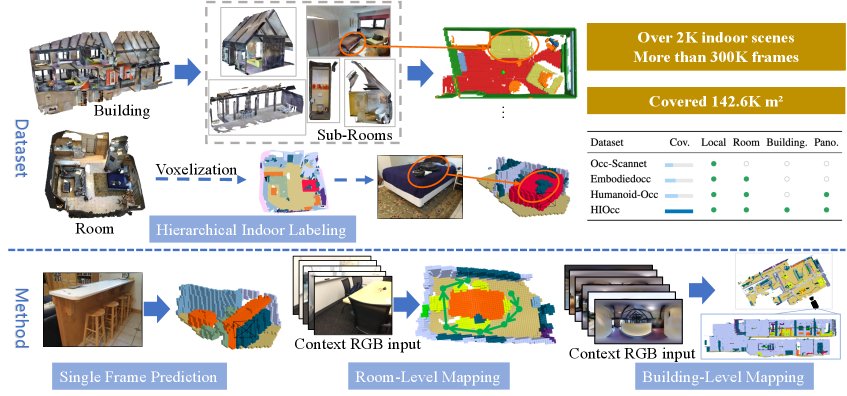
HIOcc 的价值在覆盖范围:ScanNet / ScanNet++ 支撑 perspective local 与 room-level mapping,Matterport3D 支撑 panoramic connected building-level mapping,并统一到 sparse semantic occupancy 格式。它比单一 ScanNet-style benchmark 更接近 embodied mapping 的层级需求。
评估基本支持论文的核心 claim:local、room、building 三个尺度都有,online mapping 有 progress AUC、revisit consistency、memory footprint、query latency,能看到 memory 机制的作用,而不是只看最终 mIoU。
但 evaluation 仍是离线 benchmark,不是真机部署。pose 是给定的,场景是静态的,深度/pointmap prior 可用,target 来自重建 mesh 和可见性过滤。它验证了“在标准化离线 indoor datasets 上,GEM-Occ 是更好的 semantic occupancy mapper”,但没有验证真实 embodied agent 中 pose drift、动态物体、主动探索决策和传感器噪声下的闭环表现。
另一个问题是 dataset 和 method 的共适配:HIOcc 强调 view-conditioned visibility target,而 GEM-Occ 正好以 ray evidence 和 first-hit visibility 建模。这个匹配是合理的,但也意味着部分优势可能来自 evaluation protocol alignment。
Limitation
第一,方法强依赖可靠 geometry prior。文中明确使用 depth、pointmap 或 visual geometry model 输出生成 Gaussian centers 和 ray evidence;边界、透明物体、弱纹理区域的几何误差会直接写入 memory。这里不是普通误差,而是长期状态污染。
第二,pose assumption 太强。building-level mapping 若没有准确 SE(3) pose 或 loop closure,Gaussian matching 和 submap graph 都会受影响。文中未充分说明 pose noise、drift、submap misalignment 下的鲁棒性。
第三,动态世界基本没处理。free-space negative evidence 在静态场景下合理,但在有移动家具、人、开关门时,log-odds memory 会把 temporal change 当作 contradiction 或 noise,除非引入 explicit dynamics。
第四,scalability 上限仍不清。hierarchical memory 降低了 per-area memory,但长期建筑、重复访问、细粒度类别、instance-level mapping 都会让 Gaussian 数量和 semantic entropy 管理变复杂。prune/merge 的阈值敏感性文中未充分说明。
第五,增益归因不完全清晰。local improvement 可能主要来自 stronger visual geometry / data coverage / Gaussian occupancy prior;building-level gain 可能部分来自 memory engineering。论文确实做了 ablation,但没有完全拆开 encoder 能力、dataset construction、memory update、query protocol 的贡献。
第六,尚未证明 better occupancy memory 会带来 better embodied behavior。现在证明的是 mapping metric,不是 navigation、exploration、object search 或 manipulation 的决策收益。
Takeaway
- 1. 把 pointmap / depth 当 evidence,而不是 map state,是这篇最值得迁移的思想。
- 很多 embodied perception 问题都可以借鉴这种 evidence-memory separation。
- 2. free-space 与 unknown 的显式分离是 online occupancy 的核心,不是附属细节。
- 只预测 occupied semantics 的方法在长期部署中会天然不稳定。
一句话总结
GEM-Occ 是把 visual geometry prior 从单帧 occupancy prediction 推向长期 embodied semantic mapping 的一篇代表性工作,真正贡献在于将局部几何预测重构为 visibility-aware Gaussian evidence memory,而不是简单换一个 Gaussian 表达。